He’s dangling over a gorge in Patagonia, legs swinging above the ice melt, one pole jammed into earth, one hand gripping rock. The rock gives way. He falls — slow, impossible seconds — hits the ground hard enough to crack bone and knock him unconscious. When he wakes, soaked and bleeding, he realises the only way out is forward. No rescue. No phone signal. Just 12 hours of stumbling through glacial valleys until a mountain dog, the one he’d pulled from a river days before, sniffs out the animal trail that leads him to a red roof and safety.
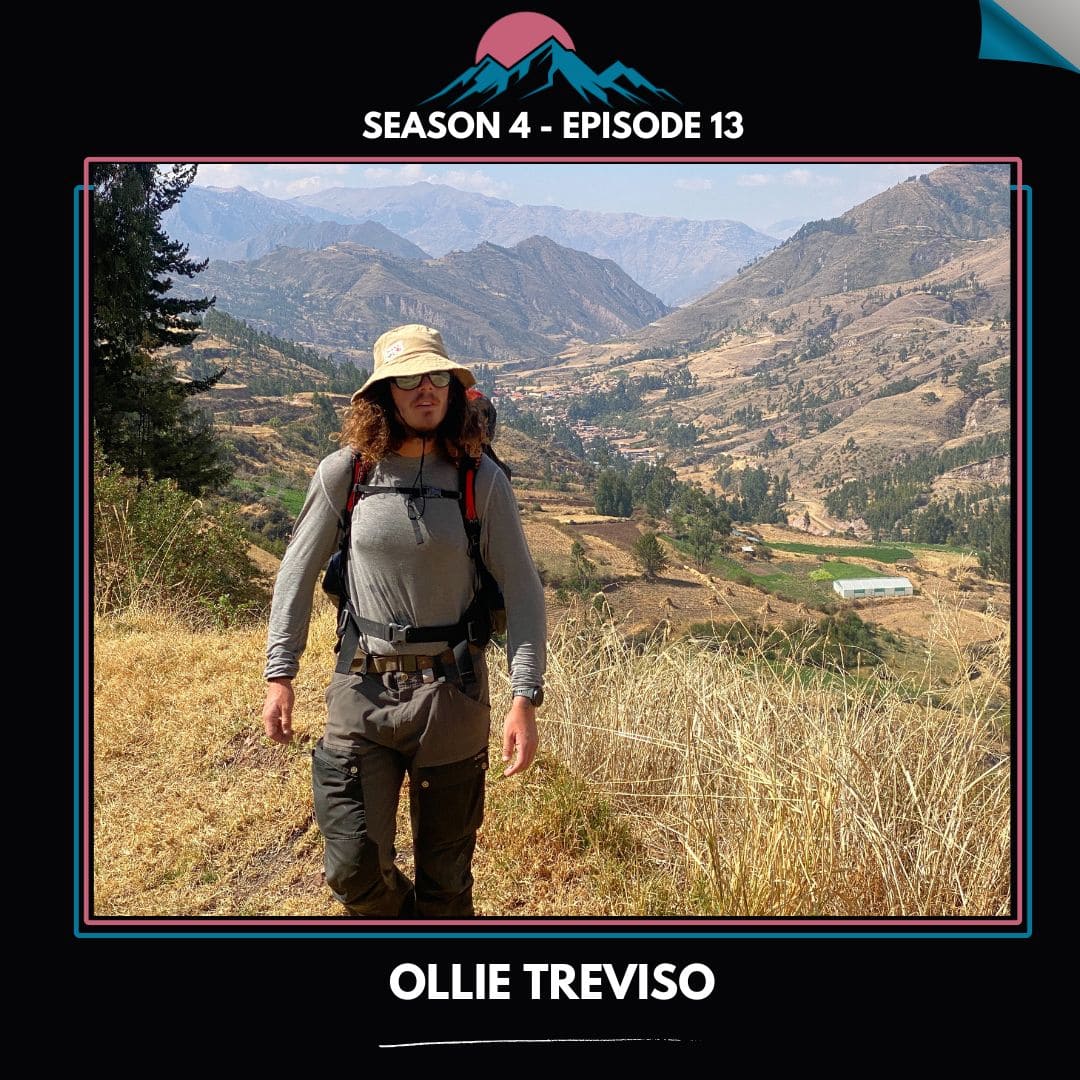
Ollie Treviso grew up in Swansea, playing rugby, fishing, spending weekends in his grandparents’ touring caravan. He didn’t call it adventure then — it was just being outside. In his early twenties he lost his way, working an insurance job he hated, going out too much, feeling trapped. A trip to Australia opened his eyes a little. He walked the Wales Coast Path, then sailed the Atlantic on a 50-year-old catamaran with a difficult captain and dolphins surrounding the bow at sunrise. But it was a book about Shackleton, and news of a cousin’s partner killed in a work accident, that lit the fuse. He booked a flight to Argentina with almost no money and barely any Spanish.
Ollie is the first person to walk the entire length of the Andes — 14,000 kilometres over 20 months, from the glaciers of Patagonia to the jungles of Venezuela, across seven countries. He raised funds for Mind Ystradgynlais, a mental health charity in the Welsh valleys, and documented every step on social media. He met hundreds of strangers who fed him, sheltered him, and walked beside him. He fractured his foot, busted his jaw, got mugged, and crossed the continent’s most dangerous border. He arrived at the Caribbean not as a conquering hero, but as a normal lad from Swansea who chose to trust the world a little more than he feared it.
A fall into the gorge.
One hundred days in, high in the Chilean Andes, Ollie set out on an eight-day stretch with no villages, no people, no safety net. A dog had been following him for three days. When the dog nearly drowned in a river crossing, Ollie jumped in and pulled him out. On the fourth day, moving along a thin animal trail, he lost his footing and fell into a gorge. He woke in the ice melt, concussed, blood on his face, his foot fractured. He couldn’t see a way out except forward. For 12 hours he stumbled through the valley, delirious, certain he was going to die at the edge of a waterfall. The dog stayed with him, licking his cuts, and eventually led him back onto the trail that took them down to a mountain police rescue station. The fall nearly ended everything, but it taught him to respect the mountains and admit what he didn’t know.
If I stop now, there’d be a problem for the rest of my life.
— Ollie Treviso
A Welshman in the desert.
Recovering in Argentina, Ollie was passed by a van. The driver stopped, turned around, and asked what he was doing. When Ollie said he was from Swansea, the man laughed — he was from Swansea too, and ran expeditions in Venezuela. He gave Ollie his number and told him his house was his house. Later, that same man let Ollie spend Christmas with his family and connected him with the guide who would walk beside him through Venezuela. It was one of dozens of moments when a stranger stopped, offered help, and changed the course of the journey. Ollie crossed the Uyuni salt flat in Bolivia — two and a half days of blinding white silence, minus 15 at night, dancing around to stay warm while hammering tent pegs into solid salt. He arrived in Peru just as his parents flew in to meet him, and in one Bolivian village during a fiesta, locals dressed in traditional outfits danced around him, fed him, and handed him the microphone to tell the crowd he was happy.
The border everyone feared.
For months, people told Ollie he was going to die in Venezuela. South Americans called it the V-word, too dangerous to even name. The border between Colombia and Venezuela — Cúcuta — is regarded as the most dangerous place on the continent. Ollie watched the news one morning and saw bombs had gone off there, exactly on his route. He didn’t tell his family. But 300 kilometres before the border, a car stopped. The driver was from Cúcuta. He took Ollie’s number, promised to help, then drove him to breakfast and introduced him to his son, a policeman who works at the border. On the day of the crossing, the man followed Ollie in his car, carried his bag ahead, and saw him through. What Ollie imagined as a war zone turned out to be people living normal lives. Over 55 days in Venezuela, he slept in 40 different houses. In the final two weeks, 30 or 40 people walked with him — fire brigade, police, biking clubs, all wearing matching t-shirts. His father and brother flew out to meet him. They finished at a cacao plantation with no road access, listed as producing the best cacao in the world. Ollie stood at the Caribbean and realised he’d already arrived.
Over 55 days I slept in 40 people’s houses. That’s what type of people they are.
— Ollie Treviso
In this conversation.
We hear how a book about Shackleton and a family tragedy pushed Ollie to book a flight to Argentina with almost no preparation, how he fractured his foot and busted his jaw falling into a gorge, how a mountain dog helped save his life, and how a Welshman in a van in the middle of nowhere turned out to be from Swansea. We hear about crossing the Uyuni salt flat in Bolivia, sleeping rough at 5,000 metres, getting mugged in Colombia, and walking into Venezuela — the country everyone told him would kill him — only to be carried through by strangers who fed him, sheltered him, and walked beside him for weeks. We hear about gratitude, mental health, the crash that comes after big adventures, and why Ollie is going home to talk to Mind before he talks to anyone else.
Call to adventure.
Ollie’s challenge is simple: go and get a wild camp in for one night. Take what you need, whether it’s on the Welsh coast path or in the hills. Get away from everything, no signal, and get a coffee going in the morning. Just give it a go.
Pay it forward.
Ollie is raising funds and awareness for Mind Ystradgynlais, a mental health charity in the Welsh valleys. The area has the highest suicide rate per capita in the UK, and the charity is on the brink of closing down. Ollie is going to visit them himself when he gets home.
About Ollie.
Ollie Treviso is the first person to walk the entire length of the Andes — 14,000 kilometres over 20 months, across seven countries, from Patagonia to Venezuela. He’s from Swansea, Wales, and before the Andes he walked the Wales Coast Path, Land’s End to John o’ Groats in winter, and sailed the Atlantic on a 50-year-old catamaran. He raised funds for Mind Ystradgynlais throughout the journey and documented the walk on social media. He’s currently in Colombia, preparing to return home in June, and plans to write a book, work on community projects, and train as a guide.
He still thinks about that morning in the gorge — the dog licking his cuts, the red roof in the distance, the 12 hours it took to find safety. He says it was the best thing that ever happened to him on the journey, because it taught him respect. Now he’s sitting on the coast, sweating in the Colombian heat, drinking his two morning coffees, thinking about the weather back home and the roast dinner he’ll share with his family. The walk is over, but the work of coming home has only just begun.