The polar bears were leaving Greenland earlier than they should have been. Dr Niall McCann noticed it during one of his expeditions across the Vatnajökull ice cap — not just the bears, but the way the ice itself had changed, the routes the indigenous hunters were taking, the conversations they were willing to have about what was disappearing. Climate change wasn’t an abstract thing up there. It was a thinning surface, a shorter season, a way of life that no longer held.
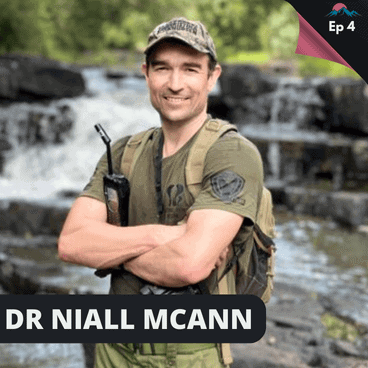
Niall McCann is a National Geographic explorer, a biologist turned conservationist, and the founder of National Park Rescue — a foundation working to prevent the collapse of African national parks from wildlife poaching. He has rowed across the Atlantic Ocean, hosted Animal Planet’s Biggest and Baddest, worked alongside Sir David Attenborough, and spent time in enough jungles, deserts, and polar regions to know that the line between exploration and conservation is mostly imaginary. What starts as curiosity about a place almost always ends in trying to save it.
He grew up in a family that normalised adventure. Not in the Instagram sense — in the sense that going somewhere difficult, for no reason other than to see what was there, was just what you did. That upbringing didn’t make him fearless. It made him methodical. When he talks about rowing the Atlantic, he doesn’t romanticise the storms or the flat calm days or the headwinds. He talks about nutritional preparation, physical training, proper planning. The difference between someone who rows an ocean and someone who talks about rowing an ocean is usually just that: preparation.
The turn towards rescue.
Somewhere between studying biology and hosting a TV show about the world’s most dangerous animals, Niall realised that documenting species wasn’t enough. He wanted to stop them from disappearing. That shift — from biologist to conservationist — is what led to National Park Rescue. The organisation works directly with government authorities and local communities in Africa, focusing on parks at risk of total failure due to poaching. It’s not about parachuting in with foreign solutions. It’s about stable employment, trade opportunities, and making sure the people who live near a park have a reason to keep it standing.
I think get to know and love your home and the places around you. We can all seek adventures in far flung places, but adventure starts at home.
— Dr Niall McCann
The same methodical approach he brought to ocean rowing, he now brings to conservation. You don’t save a national park with sentiment. You save it by understanding the economics, the politics, the community structures. You show up, you listen, and you build systems that outlast your presence.
Ice caps and spinal cords.
Earlier this year, Niall skied across the Vatnajökull ice cap in Iceland with his friends Ed Jackson and Darren Edwards. All three have spinal cord injuries. The expedition was to raise money for Millimetres to Mountains, a charity that uses outdoor adventure to help people recover from physical or mental trauma. Niall is an ambassador. He has seen what happens when someone who has been through something impossible is given a reason to move again, a landscape that doesn’t care about their injury, only their effort.
Vatnajökull is the same ice cap where he first started noticing the changes in Greenland’s wildlife patterns. It’s also where he witnessed how adventure — real, physical, uncomfortable adventure — can rebuild someone. The charity doesn’t offer therapy in the traditional sense. It offers expeditions. Public walks. Community. The kind of recovery that happens when you’re too cold or too tired to think about anything except the next kilometre.
His work in polar regions has also taken him to Greenland repeatedly, where he has encountered giant otters, snakes, and the quiet, accelerating evidence of a warming world. The indigenous communities he has worked with are not activists. They are observers. They know what the ice used to do, and they know what it does now. Niall listens to them the same way he listens to the park rangers in Africa: as the people who have the data that matters.
Media as a tool.
Hosting Biggest and Baddest wasn’t about spectacle. It was about getting people to care. Niall used the show to bring attention to animals that are misunderstood, environments that are under threat, and the quiet collapse of ecosystems most people will never see. Working with Sir David Attenborough reinforced that. Attenborough’s recent work has shifted from wonder to warning — from showing people what the natural world is, to showing them what it will lose if nothing changes. Niall sees media as a lever. Not the solution, but a way to move people toward it.
His own career has followed that same arc. Early on, it was about exploration for its own sake. Now, every expedition has a purpose. Every piece of media has a message. He doesn’t believe in adventure without consequence anymore. If you’re going somewhere, you should come back with something other than a story.
In this conversation.
We hear about the physical and mental load of rowing the Atlantic — the flat calm days that feel harder than the storms, the nutritional strategies that kept him moving, the way weather becomes the only thing that matters. Niall goes into the founding of National Park Rescue, explaining how engaging local communities is the only way conservation works long-term, and why stable employment beats enforcement every time. He talks about his expeditions in Greenland and Iceland, the wildlife encounters that changed how he understood species behaviour, and what it’s like to ski across an ice cap with two friends who weren’t supposed to walk again. We also hear about his daughter, his site-centred Ordnance Survey map, and why the few square kilometres around your house might be the most important adventure you ever take.
Call to adventure.
Buy a site-centred map from Ordnance Survey with your house in the middle. Spend the next year visiting every square kilometre on that map. Learn the names of the fields, the trees, the paths you’ve never taken. Bring your kids if you have them. Bring a camera if you want. But go slowly, and go often. Adventure doesn’t start when you board a plane. It starts when you stop assuming you already know the place you live.
Pay it forward.
Support Millimetres to Mountains, the charity founded by Ed and Lois Jackson that uses outdoor adventure to help people recover from mental or physical trauma. They run public walks, expeditions, and community programmes. Niall and Darren Edwards are both ambassadors. The charity’s name refers to the tiny movements that lead to full recovery — and the mountains those movements can eventually climb. Consider joining one of their walks, or supporting someone who needs a reason to move again.
About Niall.
Dr Niall McCann is a National Geographic explorer, biologist, and conservationist who has led expeditions across seven continents. He founded National Park Rescue to prevent the collapse of African national parks threatened by poaching. He has hosted Animal Planet’s Biggest and Baddest, worked with Sir David Attenborough, and rowed the Atlantic Ocean. He lives with his family and spends most weekends exploring the countryside north of his house with his four-year-old daughter.
The polar bears are still leaving Greenland too early. But Niall is still showing up. And he’s teaching his daughter to do the same — one square kilometre at a mapping at a time.