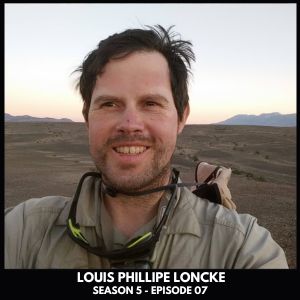
The dunes stretch ahead like a frozen sea, one after another, relentless. Louis-Philippe Loncke crests the ridge and looks down into the valley — a carpet of white flowers has bloomed overnight. He turns. Two eyes reflect his head torch. The dingo is still there. It has followed him for two hours. He keeps moving, pulling the 160-kilogram cart through sand that swallows his boots, through vegetation that drives spikes into the solid rubber tyres. By morning, he will count 200 embedded in a single wheel.
Loncke grew up in a Belgian family of furniture makers — five generations of carpenters and cabinet makers, not adventurers. His father designed kitchens; his mother sold sofas. Holidays meant museums, not mountains. But the Boy Scouts gave him his first taste of the outdoors: tying knots, pitching tents, building fires. He studied engineering, moved into IT, took a corporate job at ING Bank. Then, in 2004, a cancelled posting to New York redirected him to Singapore — and into scuba diving. That passion took him to Australia’s Great Barrier Reef, and a year-long walkabout that covered 2,000 kilometres of hiking across wildly different terrain.
Today, Loncke is a full-time adventurer and explorer — titled the Mad Belgian after more than 20 expeditions across deserts, polar regions, and mountains. He is best known for the 2008 world-first unsupported crossing of Australia’s Simpson Desert, a 350-kilometre journey that took 35 days and remains unmatched. He is an ambassador for the Jane Goodall Institute in Belgium, creator of the Expedition Database — a global archive of over 2,000 adventurers — and designer of a classification system that grades expeditions from class one to five, like white-water rapids for explorers.
The gate to hell.
The Simpson Desert is Australia’s most arid desert — the driest on the driest continent. Early European explorers called it a frozen sea of dunes and the gate to hell. When Loncke was dropped near Mount Zeil in 2007 to complete the Larapinta Trail, the people who drove him there had just crossed the Simpson by car. He asked if there were any good walking trails inside. They stared at him. It’s the Simpson Desert, they said. You don’t walk. It’s forbidden. Like asking if you can swim in the oceans of the Moon.
Loncke searched and found zero trails — which made it very appealing. He contacted Lucas Trihey, who had done the width of the Simpson in 2006. Trihey agreed to advise him. What you’ve done is really crazy, Trihey said. You might die, but you might actually succeed. In 2008, Loncke pulled a desert cart loaded with 40 litres of water and dehydrated food north to south across the full length of the Simpson — 350 kilometres in a straight line, unsupported, over 35 days. No air drops. No caches. He started where the dunes begin and ended where they finish at Lake Eyre.
They succeeded because they didn’t know it was impossible.
— Louis-Philippe Loncke
Eight hundred spikes.
The cart was custom-built with solid rubber tyres — green tyres made in England with micro-bubbles inside the rubber so they would flex slightly but never puncture. At the end of the expedition, Loncke counted the wooden spikes from desert vegetation embedded in one tyre: 200. Multiply by four wheels — 800 spikes. Could he have repaired 800 punctures in the desert? Absolutely not. On the first dune, he thought his legs were not strong enough. He was moving sand, but the cart wasn’t going anywhere. For the first week, he offloaded half the weight and shuttled: point A to point B with half the load, then back at night for the rest. Three trips per stretch. After three weeks, once the cart was lighter and he was properly conditioned, he was flying.
The other dangers were camels, dingoes, and snakes. Australia has up to two million feral camels — the purest-bred Afghan camels in the world, brought for railway construction 200 years ago. Loncke was chased twice by herds of 14 camels. He also encountered the inland taipan, the most venomous snake in the world — one dose could kill a hundred men. And dingoes. One followed him for two hours on the 2024 attempt, fancying him as dinner. He continued walking through the night with his head torch. When he turned around, two eyes reflected the beam.
Constant pain.
Loncke returned to the Simpson in 2016 without the cart — just a 60-kilogram backpack. He classifies backpack weight in tiers: zero to 20 kilograms is normal, 20 to 40 is heavy, and above 40 is not heavy any more — it’s called constant pain. He made two-thirds of the distance across the width before turning back. In 2024, he attempted a diagonal crossing with his cart to film aerial footage with a drone and finally document the 2008 expedition properly. He failed after 13 days and 75 kilometres. On day two, he developed tendinitis in his knee. The heat was brutal — 10 degrees warmer than in 2008. He woke at 2am shivering in his underwear on his mattress, too warm to need a sleeping bag. In 2008, he had slept in a beanie and gloves, and his tent had frozen two nights near the end.
I genuinely believe there’s a trend. Climate change is a fact — whatever the cause. If temperatures are rising, it may be that crossing the Simpson Desert unsupported is now impossible.
— Louis-Philippe Loncke
Class one to five.
Loncke created a classification system for expeditions, modelled on white-water kayaking grades. Class one and two are accessible — climbing Mount Everest with guides and Sherpas is class two. Class three is noticed by the adventure community — Everest without guides, proper mountaineering. Class four and five are world firsts that are remarkable, that others have attempted and failed. His 2008 Simpson Desert crossing is class five. If 20 or 30 people had done it, it would drop to class four — but he remains the only person to have completed an unsupported crossing of the full length. Above class five is an unofficial class six — reserved for adventurers who have done many class five expeditions across multiple disciplines. Mike Horn is class six. So is Jon Muir, Australia’s greatest adventurer, who made the first solo unsupported crossing of Australia and deliberately avoided the Simpson Desert because it is too hot and has no water.
In this conversation.
We hear how Loncke moved from furniture makers in Belgium to the Simpson Desert via the Boy Scouts, an engineering degree, ING Bank in Singapore, and a year of scuba diving and hiking in Australia and New Zealand. How he met French adventurer Sylvain Tesson in Paris in 2005, toasted with vodka to French desert explorers, and prepared for the Simpson by asking the right questions. How he built a cart with solid rubber tyres, shuttled loads for the first week, pulled 160 kilograms across 1,100 parallel dunes, and woke to frozen tents in a desert. How he returned twice more and failed, possibly because the desert is now too hot. How he classifies expeditions from class one to five, builds the Expedition Database, and refuses to call Instagram stunts adventure. And how he is slowing down, filming a sea-to-summit expedition in Azerbaijan, crowdfunding the Tintin rocket, and planting trees with the Jane Goodall Institute.
Call to adventure.
Climb a mountain — there is always one in your neighbourhood, or close enough. Your first 2,000-metre peak is a perfectly good starting point. Loncke recommends Mount Pico in the Azores, the highest peak in Portugal at approximately 2,351 metres. It is an old volcano, and you can sleep in the crater on the summit. You need to book in advance — numbers are limited. It is a genuine challenge on lava terrain without a marked trail, but very accessible for a strong hiker. Spectacular reward.
Pay it forward.
Loncke is an ambassador for the Jane Goodall Institute in Belgium. They organise tree-planting events across Western Europe. Last weekend, he planted one of Jane Goodall’s favourite trees in the Arboretum near Brussels — he added it to Google Maps as the Jane Goodall Tree Tribute. Planting trees is enjoyable, you are outdoors, it is important, and no one from any political background will ever say planting a tree is dumb.
About Louis-Philippe.
Louis-Philippe Loncke is a Belgian adventurer and explorer with more than 20 expeditions across deserts, polar regions, and mountains over the past 20 years. In 2008, he completed the world-first unsupported crossing of Australia’s Simpson Desert — 350 kilometres in 35 days — and remains the only person to have done so. He is the creator of the Expedition Database, a global archive of over 2,000 adventurers, and has developed a classification system for expeditions from class one to five. He is an ambassador for the Jane Goodall Institute in Belgium and is currently filming a sea-to-summit expedition in Azerbaijan. He has survived 21 near-death experiences.
The dingo eventually gave up. Loncke kept walking, pulling the cart through the frozen sea of dunes, one after another, relentless. Two weeks before he left for Australia in 2008, he read an article by Jon Muir comparing desert trekking and polar trekking — similar in difficulty, but deserts are slightly harder. And Mount Everest, Muir said, is child’s play in comparison. When the country’s greatest adventurer says Everest is child’s play and you are about to enter the most arid desert of the most arid continent, it gets frightening. Now Loncke knows why. And after three Simpson Desert attempts, he is really not going back.