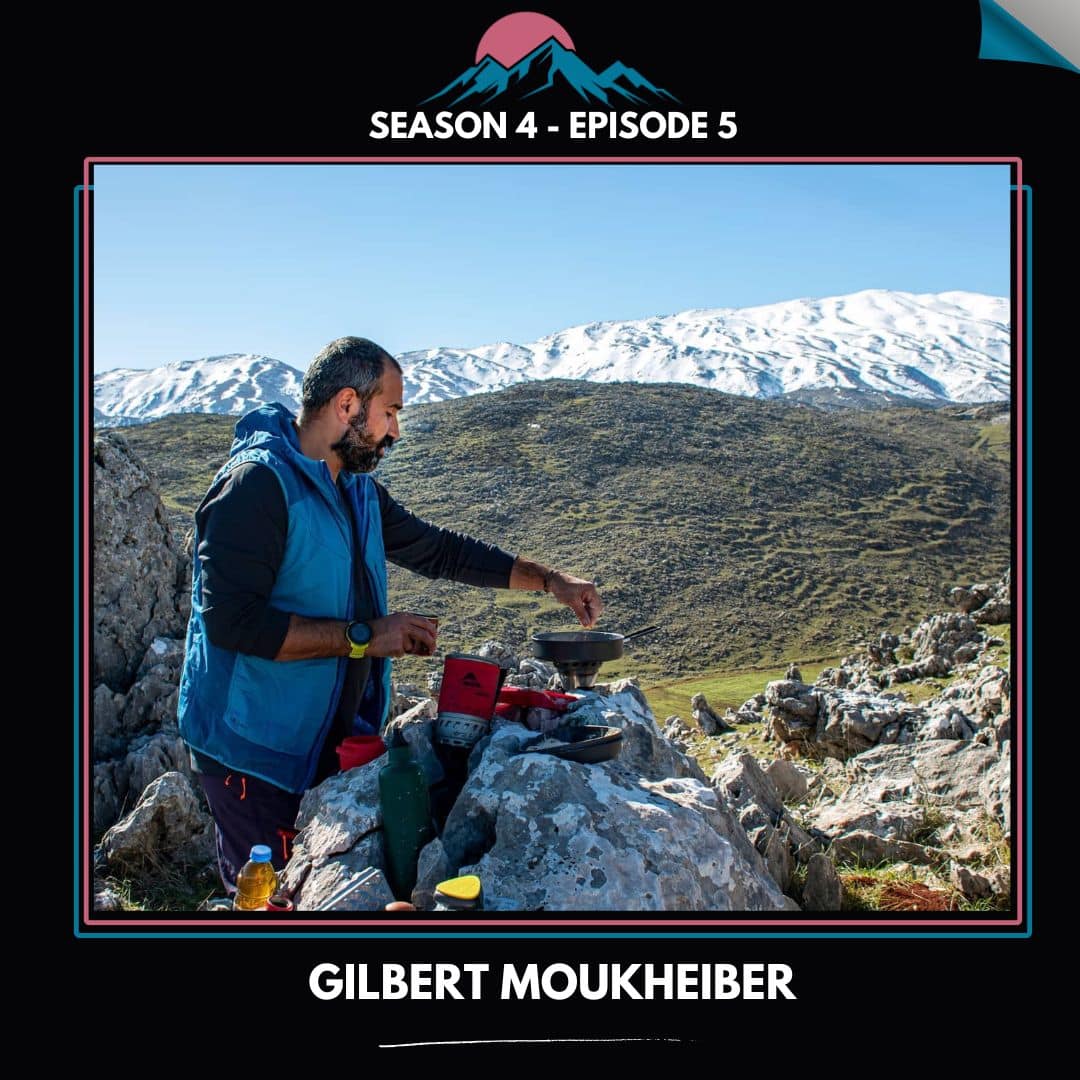
The shepherd’s tent is pitched at 2,800 metres, the wind scraping across the plateau. Inside, Gilbert Moukheiber leans over a steel plate set above glowing embers, watching dough stretch and darken into warm bread. Outside, the goats jostle and settle. In May and November, the herds move — 400 kilometres between summer pasture and winter shelter — and this year, a small group of trekkers walks with them. The tea is sweet, the air thin, and the conversation slow. For the shepherd, tourism is not the priority. The priority is the herd. The visitors are here to support that rhythm, not disrupt it.
Gilbert has spent his entire life in Lebanon, training first in caving clubs, then with French mountain guides, and later as a search-and-rescue volunteer with the Lebanese Red Cross since 1996. He studied tourism management in France and completed winter rescue leadership training in Norway. His earliest lessons came from rope work underground and on rock faces, but his deepest education has been among the shepherds.
Today, Gilbert is the founder of 33 North, an adventure company named for Lebanon’s latitude. He created the Boukaat Loubnan Trails — a 400-kilometre network crossing both the western and eastern mountain ranges — and established the Wilderness and Adventure Academy Lebanon. He also helped found Lebanon’s first mountain-leader diploma programme at university level. Each May and November, he leads the Tarhal Track expedition, walking the transhumance with the shepherds, an experience recognised by UNESCO as intangible heritage. He also runs the Lebanon Winter Expedition, the only winter expedition in the Middle East, combining snowshoeing, pulka sledging, and wilderness skills training across five days on high plateaus.
Four seasons in a single day.
Lebanon is 10,452 square kilometres, 82% of it mountainous. The highest summit, Qornet es Saouda, reaches 3,088 metres. In March, April and May, you can ski in the morning and swim in the Mediterranean by afternoon — a 30-minute drive from 2,000 metres to sea level. Eternal snow lingers on the high plateaus year-round, and every 6th of June, a Nordic skiing competition takes place above 2,800 metres. Five alpine ski resorts operate from December through March, while backcountry skiers and snowshoers can find snow into June.
Walking with the herds.
The Boukaat Loubnan Trails connect 50 remote communities along ancient shepherd paths, Roman trade routes, and Phoenician landmarks. Gilbert divided the network into three sections: the North Bekaa Trail, starting from the Temple of Baalbek; the Anti-Lebanon Trail, following the mountain range that separates Lebanon from Syria; and the Mount Hermon Trail, which passes 12 historical sites, eight of them Roman temples. The transhumance expeditions happen twice a year, timed to the shepherds’ seasonal migration. Participants pitch tents, load mules, fetch milk, and eat bread baked on steel plates over open fire. Group sizes are capped at 10 to 12 people. Gilbert interviews every participant beforehand to ensure they understand this is not a service — it is human interaction.
It’s not tourism, it’s beyond tourism. Because for the shepherd, tourism is not the priority. What’s primary for them is to take care of their herds, their goats, and we are here to support them.
— Gilbert Moukheiber
Breakfast on the plateau.
A typical morning with the shepherds begins with dairy: white cheese, labneh, yogurt. Eggs are scrambled over the fire. Za’atar is mixed with olive oil and spread on warm flatbread, sometimes baked as manoushe. Tea is served strong and sweet. Dried meat called kawarma is passed around. Preparation takes an hour. Every two hours during the day, the group stops for coffee or tea. At night, dinner is rice, potato, meat and salad, sometimes served in tents, sometimes in village guest houses or mountain chalets. When the trail passes through fertile regions in the north Bekaa, meals are occasionally held at wineries, with local wine poured by the owner.
Training the next generation.
In 2023, Gilbert co-founded Lebanon’s first university-level mountain-guide diploma programme. Six students enrolled in the first year; 18 in the second. The curriculum covers navigation, meteorology, group management, flora, fauna, history, geography, rope techniques and safety protocols. Through the Wilderness and Adventure Academy Lebanon, Gilbert also trains outdoor enthusiasts in map reading, compass use, Leave No Trace principles, belaying, winter techniques and responsible camping. Lebanon now has more than 2,000 kilometres of trails — Roman, Ottoman, Phoenician, geological — and hiking has become the country’s most popular tourism activity by observation, if not by official statistic.
In this conversation.
We hear how Gilbert grew up scrambling in Lebanon’s mountains, trained in France and Norway, and spent nearly three decades guiding trekkers and training rescuers. We learn about the Boukaat Loubnan Trails and the twice-yearly transhumance expeditions that follow the shepherds across 400 kilometres of plateau and valley. We explore Lebanon’s four-season climate, its Roman and Phoenician heritage, and the Lebanon Winter Expedition — the only winter expedition in the Middle East. Gilbert explains the principles of responsible tourism, the importance of preserving mountain communities, and his vision for global partnerships between shepherd cultures. We also hear about Lebanese food, winter rescue missions, and the long-term work of positioning an underrated country on the international adventure map.
Call to adventure.
Gilbert invites you to join the transhumance in May or November, walking with the shepherds and their herds between winter pasture and summer plateau. Alternatively, consider the Lebanon Winter Expedition — five days of snowshoeing, pulka sledging and wilderness skills training on high-altitude plateaus where temperatures can drop to minus 20 degrees. Both experiences are small-group, slow-paced and designed for human connection, not mass tourism.
Pay it forward.
Gilbert’s work directly supports the mountain communities of Lebanon — shepherds, farmers, and villagers along the Boukaat Loubnan Trails. By visiting Lebanon and walking these trails, you contribute to the preservation of traditional livelihoods and UNESCO-recognised cultural heritage. Gilbert is also seeking partnerships with trail development organisations and shepherd communities worldwide to share knowledge and create collaborative projects.
About Gilbert.
Gilbert Moukheiber is an expedition leader, mountain guide and founder of 33 North, an adventure company based in Mount Lebanon. He has been a volunteer search-and-rescue operative with the Lebanese Red Cross since 1996 and holds two master’s degrees in tourism management and tourism engineering from the University of Perpignan in France. He created the 400-kilometre Boukaat Loubnan Trails and established Lebanon’s first mountain-leader diploma programme at university level. He also founded the Wilderness and Adventure Academy Lebanon and leads the annual Lebanon Winter Expedition. In 2024, he was part of the Lebanese rescue team deployed to Turkey following the earthquake.
Back on the plateau, the bread cools on a cloth. The shepherds pour more tea. The goats settle for the night. Tomorrow, the group will walk again — slowly, without rush, following the rhythm of the herd and the season. This is Lebanon as Gilbert knows it: not a destination to be consumed, but a place to be lived, one careful step at a time.