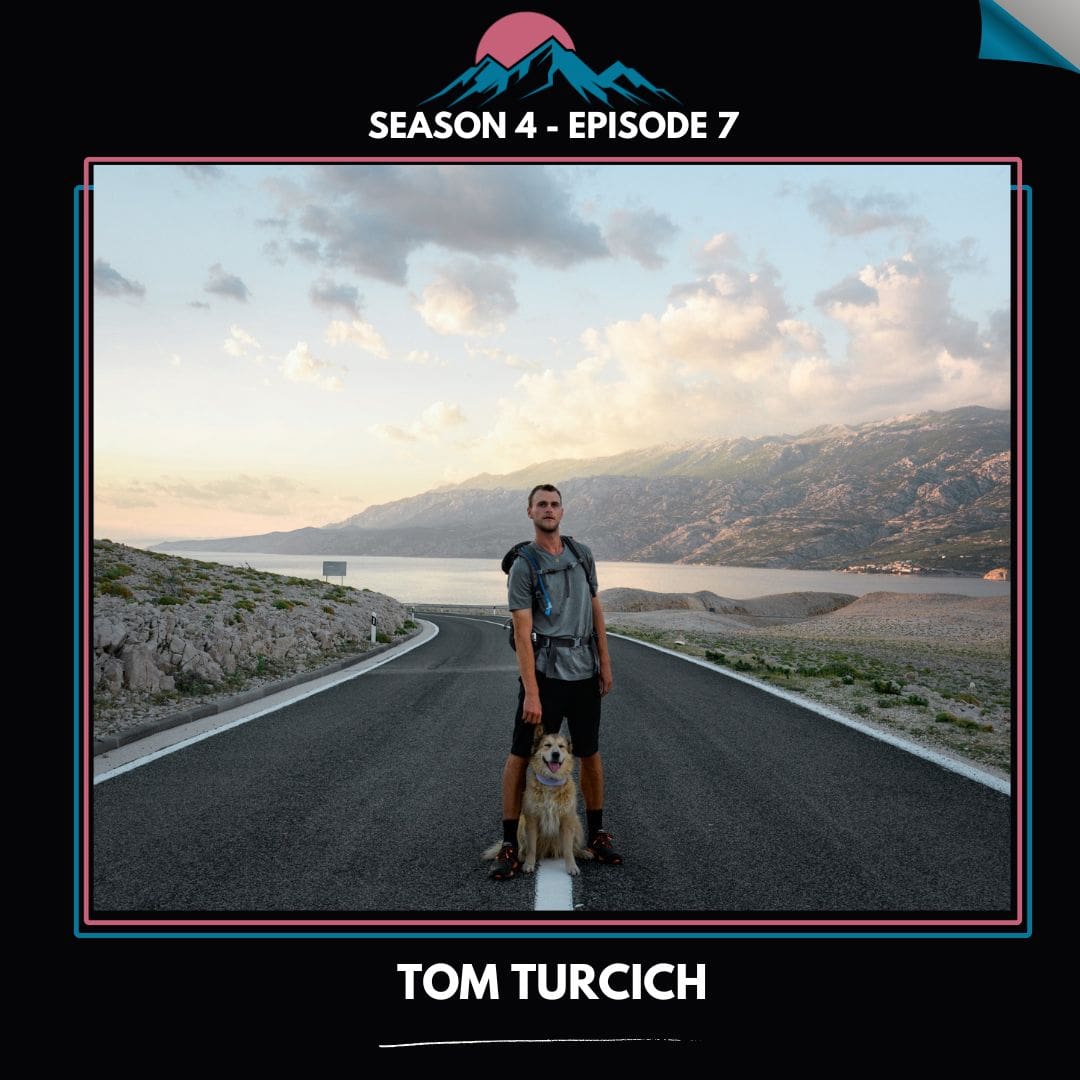
At 15,000 feet on the Altiplano between Chile and Argentina, Tom Turcich collapsed from exhaustion. Savannah — his rescue dog and walking companion — came and lay beside him in the thin air. Around them stretched the high desert plateau, empty and vast. Tom knew he had pushed his body to the absolute limit. He knew exactly where that line was now. It was a perfect moment, he says — reflecting on how far they’d come together.
Tom grew up a few blocks from the river in New Jersey, in a loving middle-class household. His mum designed toys for Mattel. His dad was a caterer — their garage had two big freezers filled with shrimp and steak. Tom had no grand designs until his friend Anne-Marie died when he was 17 and she was 16. That sudden loss made death immediate, inescapable. It also gave him a strange fearlessness — if death was inevitable regardless, he could embrace life more fully and take the risks he’d otherwise have avoided.
Today, Tom is the tenth person ever to walk around the world and the first to do it with a dog by his side. Over seven years he covered 28,000 miles across six continents. He has written a book — The World Walk — and now speaks on stages about resilience, meaning, and what he learned walking through 38 countries with Savannah at his side.
Choosing the walk.
After Anne-Marie’s death, Tom went through a phase of pure Carpe Diem — doing everything he possibly could. Then he ran out of energy and realised he had to choose what he actually valued. What he wanted most was to travel, to gain understanding, and to be forced into adventure. He was timid and introverted as a kid and wanted to grow out of that. On the travel blogs he spent his nights reading instead of doing homework, he discovered Steve Newman and Karl Bushby — two men who had walked around the world. The moment he saw that, it was like a light going on.
Walking through fear.
The early months were terrifying. In Central America, before leaving his hotel each morning, Tom needed 20 minutes of meditation just to build the strength to step outside. Passing through Mexican and Guatemalan cities with Savannah as a puppy and a big cart, his brain ran at 100 per cent just processing everything. He would collapse under a tree in the countryside, relieved to have made it through. But as the months wore on, he realised that almost all fear is just a lack of understanding and experience. By the end of the walk he was too relaxed — the adventure had almost run its course.
I knew going into this that there was a chance I’d go out there and not make it back. But because I knew that death is going to come and it doesn’t matter when it comes, it gave me a sort of recklessness that allowed me to embrace life more fully.
— Tom Turcich
Savannah and the desert.
Tom had no plans for a dog before the walk. But after four months of camping in strange places, he kept thinking how nice it would be to have one listen while he slept. In Austin, on a whim, he visited an adoption centre. He was about to leave when volunteers brought out Savannah and her sister — four-month-old puppies found on the side of a highway. A woman who spent every day at the shelter told him: if you leave, they’ll be gone. The puppies never last. Tom adopted Savannah on the spot. The first few months he didn’t feel much towards her — he was too caught up in survival. It wasn’t until South America, in the desert, that he relaxed enough to look at her and feel grateful. By the last stretch from Seattle back to New Jersey, after six and a half years, she would walk with her ear brushing his calf for eight hours. When he turned off the road and said “go ahead,” she would take off into scent mode. She was a working dog, truly.
Breaking down and building back.
Towards the end of South America, Tom picked up a bacterial infection. It worsened slowly — stomach spasms that caused him to crumble to the ground and black out in Ireland and Scotland. He lost 45 pounds at his worst. He spent a month in and out of the Royal London Hospital’s infectious disease ward. They couldn’t figure out what was wrong. He flew home. When he picked the walk back up in Europe, his body had recovered but his mind was still dealing with darkness. Walking gives you nowhere to hide from yourself, he says. You have to be good company to yourself. He briefly considered quitting — but when he imagined going home, getting a nine-to-five, buying furniture, it seemed absurd. This life was fulfilling everything he wanted.
In this conversation.
We hear how Tom processed mortality after losing his friend Anne-Marie at 17, how he settled on the idea of walking around the world, and how he adopted Savannah in Austin. He describes the mental resilience required to walk 24 miles a day through deserts, war zones, and illness. He reflects on the philosophy he developed over seven years — that we are just really tiny, that life is decided by much bigger forces, and that it’s okay to just have one rich, beautiful life. He talks about almost perfect existence on the walk, the trade-offs of settling back into routine, and his work now as a keynote speaker and author.
Call to adventure.
Tom suggests the Camino de Santiago — especially for older listeners. It’s accessible. You can have your pack sent ahead, walk 15 miles, have some good olives, a cold beer, sit in the shade. Meet people. Have a nice dinner every night. If you want the experience of walking but don’t want the hardship of sleeping rough, the Camino is the most accessible, beautiful way to get the benefits while living fairly well.
Pay it forward.
Tom asks listeners to bring awareness to the country of Georgia — a place where he first truly gained an appreciation for democracy. It’s an ex-Soviet country with only 3 million people and no natural wealth, but there’s an incredible electricity in the air because everyone is hustling and they care about their democracy. The country is being slowly corrupted by Russian influence and a party called Georgian Dream, run by an oligarch with wealth equivalent to one-third of Georgia’s GDP. Tom wants to bring light to one of his favourite countries and their fight for democracy.
About Tom.
Tom Turcich is the tenth person ever to walk around the world and the first to do it with a dog. Over seven years he walked 28,000 miles across six continents with his rescue dog Savannah. He is the author of The World Walk and works as a keynote speaker. He studied Spanish, French and Italian on the road using the Michel Thomas method. He lives in northern Kentucky with his fiancée Bonnie. His mum always told him: pay attention. It’s the best advice he ever received.
Up on that high plateau, collapsed beside Savannah, Tom knew where his limit was. He also knew it was enough. The walk had given him that — not transcendence, just clarity. You are existing right now, he says. That is a beautiful, incredible thing. You don’t need to become anything more.