An unmarked vehicle pulls them over on a lonely stretch of Kazakh highway. The driver steps out. Max and Joel brace themselves — secret police, extortion, who knows what. The man walks to their car window, speaks emotionally in Russian, then rushes back to his own vehicle. He returns carrying a giant leg of lamb. He wants to welcome them to Kazakhstan. Terror dissolves into absolute joy in the space of thirty seconds.
Max White, Joel Chevaillier and Becca Marsh met as strangers. Max had posted a simple idea on Facebook one summer — drive around the world in cars costing less than £100. Becca, a former fine art student finishing her teacher training, saw it as a chance to take the gap year she never had. Joel, backpacking through Europe, met a Portuguese guy in an Amsterdam bar who connected him to Max’s improbable plan. Six months later they set off in two beat-up cars — a £150 Vauxhall Micra and a £75 Škoda — with no real route, minimal sponsorship and maximum faith.
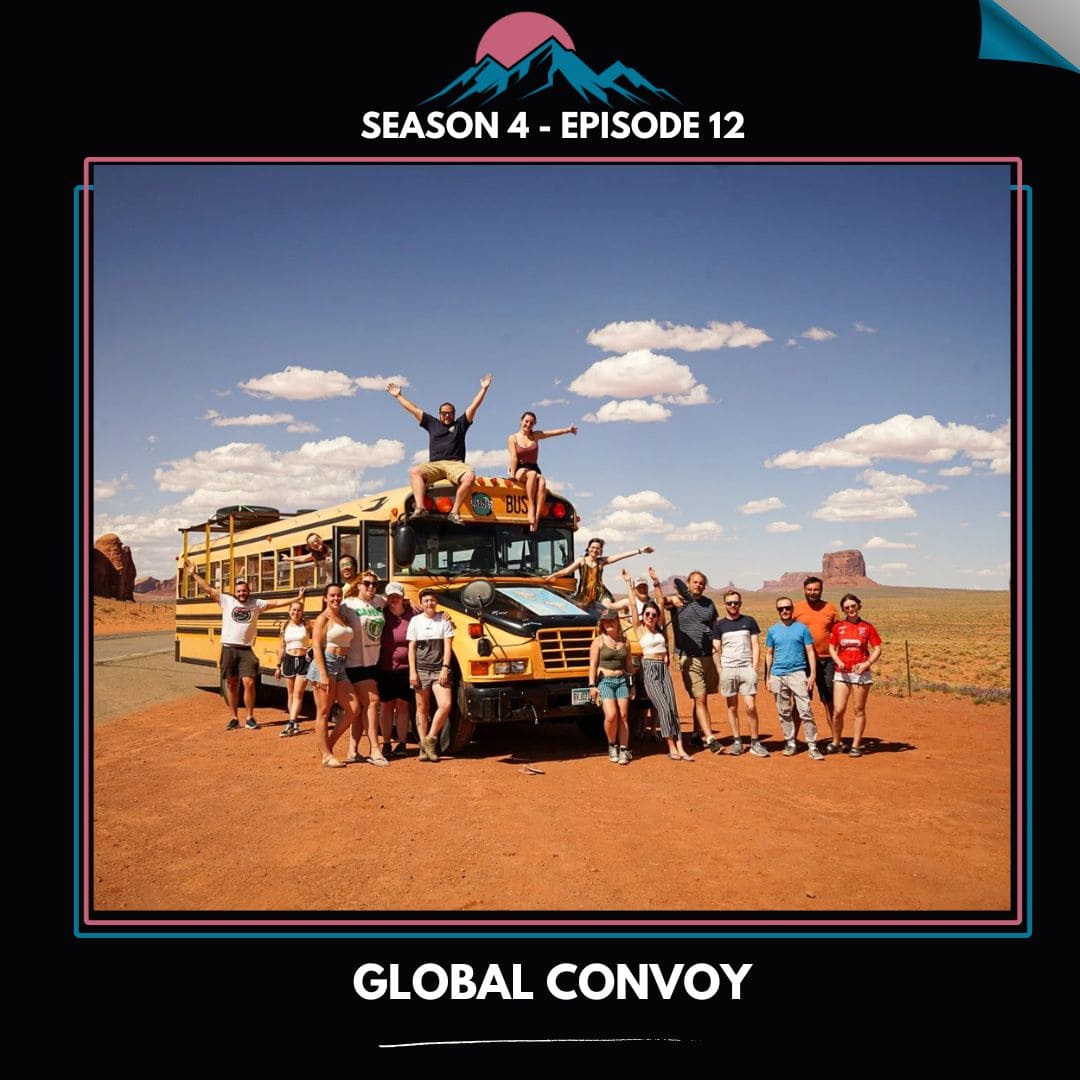
What began as a pipe dream turned into a year-long convoy of five vehicles and twenty-five people, stitched together by hitchhikers and happenstance. Today they run Global Convoy, leading Mayhem trips across continents and operating a converted yellow American school bus — Stacey’s Mum, later Babs — which they drove the full length of the Pan-American Highway from Alaska to Argentina over 243 days. They are now ambassadors for Adventure Mind, championing the science of why being outside transforms mental health.
The £75 gamble.
They chose the cars precisely because they were cheap enough to be expendable. Max had run the Mongol Rally before and knew that a vehicle you are not precious about gives you confidence in the weirder corners of the world. The Škoda was the cheapest listing on Gumtree at the time — it needed help to start, but once going it was fine. They gave both cars MOTs to confirm they would not kill anyone, cut every other corner, christened them Disco Tits and Longboat, and pointed them east. The beauty of such basic machines was that they became tinker toys — parts could be swapped out, rims bashed back into shape at Central Asian garages for about ten dollars. The only forward-looking maintenance was a timing belt change in Moscow for seventy dollars.
The route was a conversation.
Planning was minimal. They knew they needed visas for Russia and Uzbekistan, knew they would have to ship the cars at some point, and beyond that it was wake up, hold a community circle, aim for wherever someone mentioned the night before, get distracted on the way. The broad arc — Europe to Russia to Central Asia to Japan, then ship to North America and down through the Americas — was sketched, but the details were invented daily. People joined for weeks or months, dropped out to work, then flew back in. At its peak the convoy swelled to seven vehicles. At its lowest, just the original two.
I thought it sounded very scammy, but it turned out not to be.
— Joel Chevaillier
Borders, insurance and the right-hand drive problem.
The biggest bureaucratic nightmare hit in North America. The cars were too old for standard insurance, and having been shipped from Russia rather than the UK, the layers of complexity left them stranded in Canada for weeks. Joel eventually found a kind of valet insurance — technically they were allowed to drive anyone’s car in the US but not their own. Later, approaching Nicaragua, they discovered Costa Rica had just banned right-hand drive vehicles after a serious accident. Nicaragua and Costa Rica share reciprocal arrangements, so they were turned back at the border and forced to ship from Honduras instead of Panama — an unscheduled detour and a big bill.
Japan, Uzbekistan and the kindness of strangers.
Joel’s favourite place was Japan. While waiting for the car shipment from Vladivostok to Vancouver, they flew cheap to Seoul via Japan and hitchhiked the length of the country for two or three weeks. One night they stayed in a stranger’s office. The next day he invited them to a traditional iron-smelting festival, handed them the bellows, and they found themselves stoking a furnace while a katana was forged from scratch. Max had been to Uzbekistan on the Mongol Rally and had the worst time — ill, harassed by police. He returned with low expectations and instead experienced day after day of locals pulling them off the tourist trail: someone’s farm, the best melons in the province, constant heartfelt hospitality. Becca fell in love with South America, where driving through the Andes gave them access to rural areas tourists never see and where they encountered the truest kindness.
From hitchhikers to family.
Trust was a gamble. Most hitchhikers who joined stayed for months rather than days. If someone did not fit, they usually removed themselves quietly at the next stop. Lucas, a hitchhiker meant to join for a week, ended up in Guatemala seven months later phoning his mum to apologise. He then flew home to Canada, bought a car, and returned with three Belgians. Five people did the full trip start to finish. The community became the point — not the destinations, but watching people grow and change on the road.
The bus.
They had always joked about upgrading to a double-decker. In 2022, around a Moroccan campfire during Mayhem, a friend of a friend named Nick offered to help organise a bus in the US. None of them took it entirely seriously until Nick kept following up. His family had a workshop. By 2023 they owned a yellow American school bus — Stacey’s Mum, later Babs — and were planning the Pan-American Highway, the route they had partially covered on the round-the-world trip but never completed from Alaska to Ushuaia. They ran a test month across the US, lost the transmission within days, sourced the only replacement in Minnesota, and had mechanics install it with the caveat that if it did not work, they were on their own. It worked. From Alaska to Argentina took 243 days, including a two-month shipping delay in Cartagena, Colombia, where they lived off five dollars a day and traded drone footage for hostel beds. At journey’s end they sold Babs to a man in South America who converts vehicles for Pan-American adventurers. He saw the graffiti signatures of everyone who had ridden with them and vowed not to remove a single one.
In this conversation.
We hear how a Facebook post and two cars costing less than £100 turned into a year-long round-the-world convoy of strangers and hitchhikers; the mechanics of keeping £75 vehicles alive across continents; why Uzbekistan surprised Max, Japan astonished Joel, and Peru captivated Becca; how they built Global Convoy and the annual Mayhem trips from post-adventure blues; the story of the yellow school bus and 243 days driving the full Pan-American Highway; the Kazakh leg of lamb, the Japanese sword forge, and the narrowest streets of Granada; and why being outside with a rolling community changes lives.
Call to adventure.
Find a summer job in nature. Whether you are young or old, find a seasonal gig somewhere beautiful and different — guiding, backpacking, even an ice cream stand in a national park. It is a gateway into the world in a financially sustainable way. And if you want to travel as a community rather than alone, join Global Convoy.
Pay it forward.
Max, Joel and Becca are ambassadors for Adventure Mind, the organisation created by Belinda Kirk that works with healthcare professionals, adventurers and scientists to explore the evidence for why being outside is good for mental health. They are collecting data on the road because they see these changes firsthand in people who join their trips. They also recommend Explorers Connect, a community for people just starting out in adventure, and encourage supporting local organisations working to get the next generation outside and away from screens.
About Global Convoy.
Max White, Joel Chevaillier and Becca Marsh founded Global Convoy after driving around the world in two cars costing less than £100, assembling a rolling community of twenty-five people across five vehicles along the way. They now lead overland adventures including the annual Mayhem trip and have completed the full Pan-American Highway in a converted school bus. They are ambassadors for Adventure Mind and continue to champion the transformative power of community-based adventure.
Somewhere on a Kazakh highway, an unmarked car still pulls over. A stranger still steps out. And in the seconds before he returns with a leg of lamb, there is that heartbeat of fear — the not knowing. Then the gift, the gesture, the overwhelming kindness. That is the gap Global Convoy lives in: the space between what you fear and what actually happens when you trust the road.