Kristin Harila completes the Everest triple crown.
On 27 May, Kristin Harila reached the summit of Everest. It was the third peak in a set that only four people had ever completed in a single season, and that no woman had completed at all.
She had started 10 days earlier on Nuptse, at 7,861 metres, which she climbed without bottled oxygen. Then came Lhotse, at 8,516 metres. Everest, at 8,848, finished it.
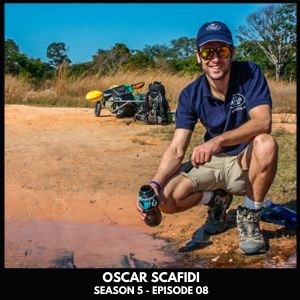
She is 40, and she did not climb alone. The Nepali guide Mingtemba Sherpa was with her on all three peaks and completed the set too. It is worth remembering how often these records depend on the Sherpas who make them possible. Cathy O’Dowd, the first woman to climb Everest from both its north and south sides, has told her own story on the podcast.
Sources: Kathmandu Post; Gripped; Outside Online.
Giant squid detected off Ningaloo by environmental DNA.
Off the Nyinggulu coast of Western Australia — the reef most people know as Ningaloo — a research ship spent days lowering sampling lines into two deep canyons. The team was not trying to catch anything. They were collecting seawater.
In that water they found traces of the giant squid, Architeuthis dux: genetic material it had shed, picked up in six separate samples from both canyons. No one saw the animal. It was the first record of a giant squid in Western Australian waters, and the furthest north one has been confirmed in the eastern Indian Ocean.
The survey was led by Curtin University and the Western Australian Museum, aboard the research vessel Falkor. It read more than 1,000 samples from depths reaching 4,510 metres and logged 226 species, including Cuvier’s beaked whale and the pygmy sperm whale — animals confirmed not by sight, but by the environmental DNA they leave behind in the water.
Sources: Curtin University; the study in Environmental DNA; Oceanographic.
The podcast
Follow the adventure.
For authentic stories of adventure, exploration & the natural world.
A hidden basin network found beneath East Antarctica.
Beneath the East Antarctic ice — more than three kilometres thick in places — the ground is not as simple as it looks from above.
A team working from Durham University and the University of Genoa has shown that several of the continent’s best-known buried basins are part of one connected structure. The Wilkes and Aurora basins, and the trough that holds Lake Vostok, the largest lake under any ice sheet on Earth, form a single fan of stretched crust. Each had been studied on its own. Their connection is new.
Writing in Nature Geoscience, the team describes crust that pulled apart as the old supercontinent of Gondwana broke up and Antarctica and Australia separated. It spread, roughly, like fingers from a fixed thumb. This matters beyond geology: the shape of the rock decides how the ice above it moves, and which parts are most at risk as the climate warms. Justin Packshaw kite-skied across this ice, and described the crossing on the podcast.
Sources: Durham University; the paper in Nature Geoscience; Phys.org.
Scottish wildcats breed in the wild in the Cairngorms.
By 2019, the Scottish wildcat was, in practical terms, gone from the wild. Too few were left, and too many had bred with farm and domestic cats, for it to count as a wild population any more.
Then the releases began. Since the summer of 2023, the Saving Wildcats project — led by the Royal Zoological Society of Scotland with NatureScot and partners in the Cairngorms — has put 46 captive-bred cats back into the national park. Most have done well. All but one survived the first 10 months, and they put on weight as they learned to hunt.
What matters more is what came next. At least nine of the released females have had kittens in the wild, across the springs of 2024 and 2025 — the first wild-born Scottish wildcats in living memory. A species that was written off within a few years is now raising its own young on the hill.
Sources: Saving Wildcats and RZSS; NatureScot.
Ptilotus senarius rediscovered after nearly sixty years.
Aaron Bean was banding birds on a remote property near the Gulf of Carpentaria when he stopped to photograph a few plants that caught his eye. One was a slender shrub with purple-pink flowers. He uploaded the photos to iNaturalist and thought little more of it.
The pictures reached Anthony Bean — no relation — a botanist at the Queensland Herbarium who had described the species himself, 10 years earlier. He recognised it at once. It was Ptilotus senarius, last collected in 1967 and not seen since. For nearly 60 years it had been counted among the plants assumed lost for good.
The find has moved it off the presumed-extinct list and onto the critically endangered one — which, for a plant, is better news than it sounds. It took a phone, a sharp eye, and a landowner willing to help. Decades of formal survey had not managed it.
Sources: UNSW; the original iNaturalist record; Queensland Herbarium.
Five stories, from a Himalayan summit to a patch of outback scrub. Different worlds — all of them still worth a moment’s attention.