The villagers came towards him in the dark, speaking a language he didn’t understand. One man held a machete. They touched him, circled him. Ricardo’s guide couldn’t explain what was happening. Later, at the church refuge lit by a single generator, a priest told him someone in the village had seen a witch two days before. The instruction was simple: capture it, or kill it. Ricardo had been walking through the jungle with a red headlamp, the only light for miles.
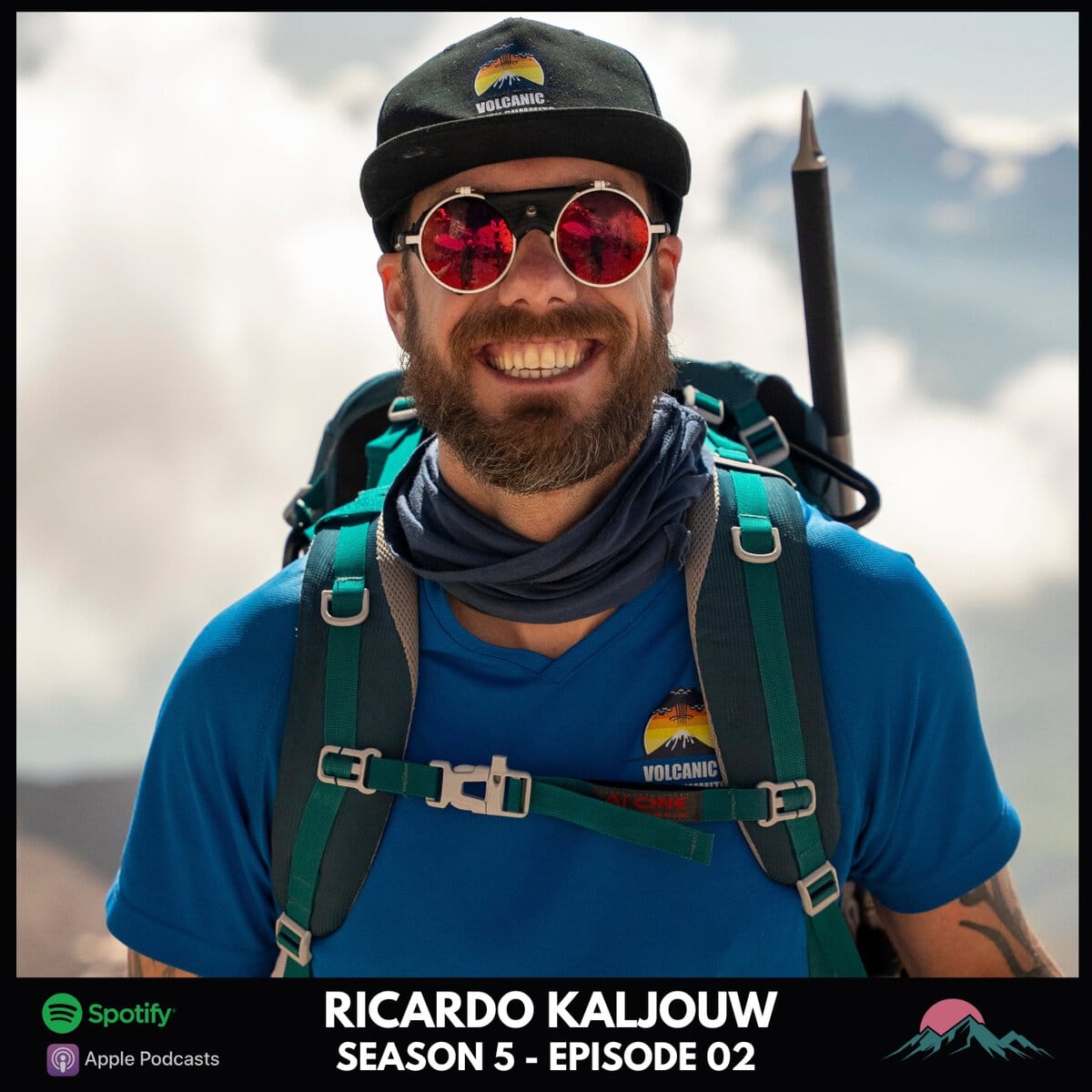
Ricardo Kaljouw grew up in Vlissingen, a small fishing town in the Netherlands — one of the flattest countries on the planet, much of it below sea level. His parents channelled his abundant energy into a walking club, where he learned to navigate and cover distance across the islands of Zeeland. The North Sea drew him into the Royal Dutch Navy, where he deployed to the Gulf of Aden in 2010, armed and hunting pirates.
Today he works in military shipbuilding, but his free time belongs to the volcanoes. Earlier this year he became the first person from the Benelux region to complete the Volcanic Seven Summits — the highest volcano on every continent — a journey that ended 1,000 kilometres from Union Glacier Camp, stranded in Antarctic wind at minus 28 degrees, questioning whether he’d have to return the following year.
The lava lake.
Kilimanjaro was his first high volcano, climbed in six days after a safari in Mombasa. It felt like the hardest thing he could do. But the real love began in the Democratic Republic of Congo, sleeping on the crater rim of Nyiragongo above the world’s largest lava lake. The lava bubbled and surged, glowing red in the dark. He could hear it rumbling — a long, low bass that vibrated through the rock. Everything around it was sketchy: militia, instability, danger. But the volcano was authentic.
Learning on the ice.
He’d never been to mountaineering school. He learned everything on the volcanoes themselves — knots, crevasse rescue, glacier travel — asking his guides to teach him until he could almost do it alone. On Damavand in Iran, he climbed through a winter snowstorm at 6,000 metres. Visibility was low, so he removed his sunglasses because the inside kept freezing. He summited, descended, and an hour later his eyes began to hurt. Snow blindness. He walked down like a blind man, double-stacked with sunglasses, learning the hard way that if you have the equipment, you use it.
When you think you’re at 100%, you’re literally at 70%. You can go way beyond.
— Ricardo Kaljouw
Stranded at minus 28.
On Ojos del Salado in the Atacama Desert — the highest volcano in the world, almost 7,000 metres — they started too late. One person was left behind at the crater in minus 25 degrees and had to be carried down. The guides dispersed. Ricardo found himself alone at 6,600 metres in deep snow with no visibility and no one around him. He sat in the snow and waited for the sun to come up, torch on low to spare the battery, calculating hours until dawn. Eventually a second group found him — a single light in the white.
The frozen continent.
Antarctica cost 75,000 US dollars. He waited in Punta Arenas for the weather, then flew over the Drake Passage in a converted DC-3. The continent looked like low cloud until they descended and he saw the texture: crevasse fields, mountains like stracciatella, wind scoops carved into the ice. They landed the plane on the ice. At Union Glacier Camp he met adventurers heading to the South Pole, Mount Vinson, emperor penguin colonies. Then he flew 1,000 kilometres further in a Basler turboprop to Mount Sidley, the most remote volcano he’d ever attempt.
His guide got pulmonary oedema the night before the summit push. They buried their gear and descended. For almost two weeks they waited at base camp in 24-hour daylight, three people in a radius of 1,000 kilometres. Other expeditions tried and came back with cold injuries so severe that noses had to be amputated. The weather turned again and again. With three days left in the season, they made one final attempt. At minus 42 degrees, Ricardo stood on the crater rim and looked 360 degrees across the frozen world. He’d become the first from the Benelux to complete the Volcanic Seven Summits, and one of around 68 people in the world to do so.
In this conversation.
We hear how Ricardo went from fighting pirates in the Gulf of Aden to sleeping beside a lava lake in the Democratic Republic of Congo. How he climbed Damavand in winter and learned the cost of snow blindness. How he was mistaken for a witch in the jungles of Papua New Guinea, proposed to his wife on Pico de Orizaba, and spent two weeks stranded in Antarctica waiting for a summit window that almost never came. And how, after summiting Mount Sidley, he flew back to Punta Arenas in 26 hours and tried to make sense of the noise and light of the civilised world.
Call to adventure.
Ricardo suggests two volcanic experiences. First, Ubinas in Peru — a very active volcano near Arequipa where you can descend into the crater itself, not just stand on the rim. Second, Jan Mayen, the most northern active volcano in the world, a glaciated island rising 2,500 metres from the sea between Iceland and Svalbard, accessible only by sailing boat.
Pay it forward.
Ricardo supports the Virunga Foundation, protecting Virunga National Park in the Democratic Republic of Congo — the first national park in Africa, home to endangered species and the rangers who risk their lives to protect them. It’s the place that gave him his passion back.
About Ricardo.
Ricardo Kaljouw is a Dutch adventurer and mountaineer from Vlissingen in the Netherlands. He works in military shipbuilding and trains six days a week — three cardio, three weights — to prepare for expeditions at altitude. He is the first person from the Benelux region to complete the Volcanic Seven Summits and one of around 110 people to have summited Mount Sidley in Antarctica. He is currently working on the Volcanic Grand Slam, climbing the highest volcanoes in 25 countries. His book, A Million Steps on Lava, is now available in Dutch, with an English version to follow.
When the villagers finally let him pass, Ricardo walked back to the refuge and learned what fear looks like when it’s shaped by rumour and red light. Now, when he looks at the picture on the cover of his book — standing on the crater rim of Nyiragongo above the lava lake — he remembers that the wildest encounters aren’t always with the volcanoes themselves.