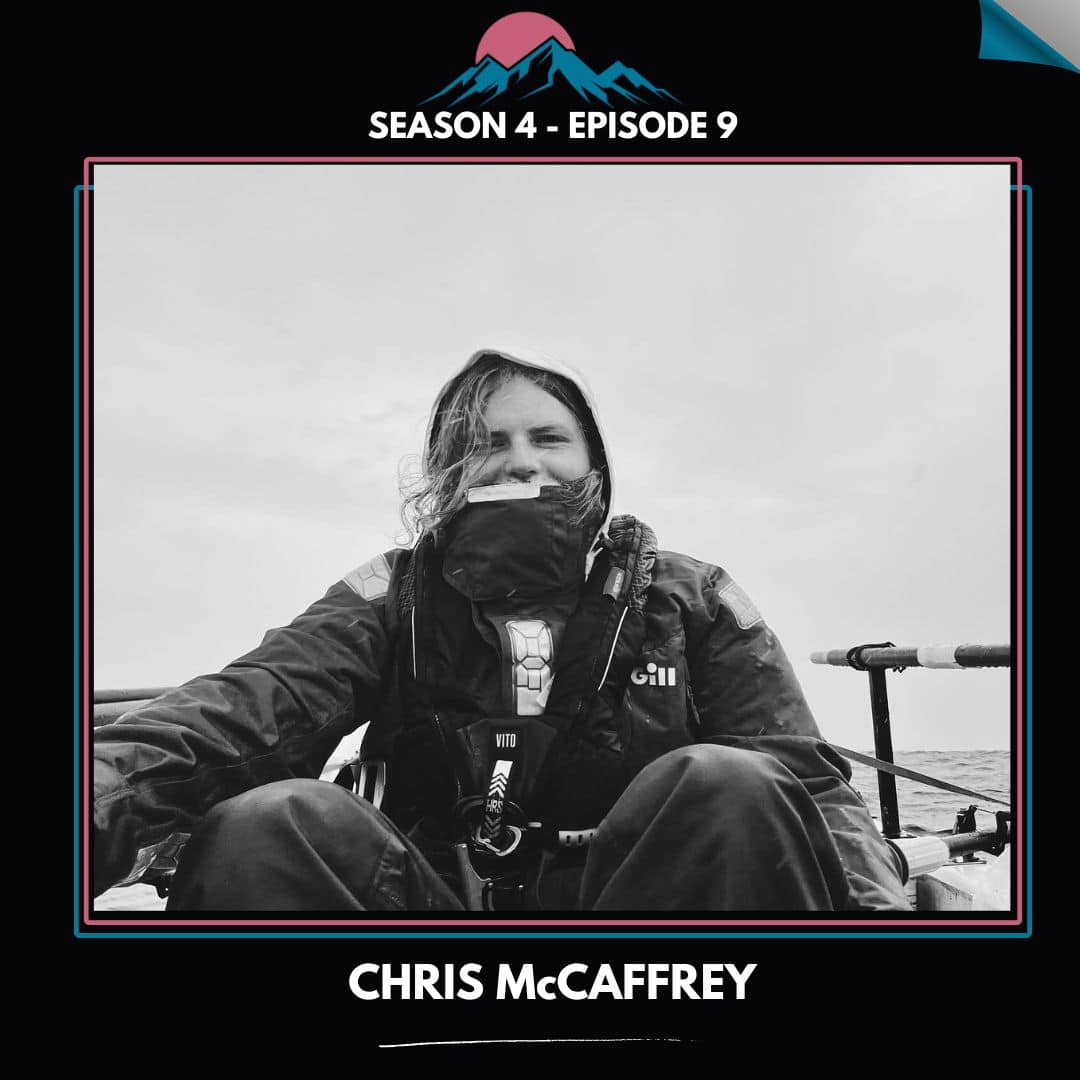
The wave hit from a different angle. It threw the boat over and flung Chris McCaffrey from his sleeping bag straight up into the cabin ceiling. He’d gone from sound asleep to airborne in the North Atlantic, a thousand miles from land, in the middle of a hurricane. An auxiliary battery — ten kilos of metal — had been launched at similar force and missed his crewmate’s head by about a foot. Later that day, another wave ripped the entire steering system clean off the back of the rowboat, snapping the steel shackle in half.
Chris grew up in Atlanta, Georgia, far from mountains but close to water. His father was a sailor, his grandfather grew up on Long Island Sound, and Chris spent his childhood racing dinghies — Optimists, then lasers — travelling across North America for regattas. His mum was a competitive water skier. American football dominated his high school years, but he’d already fallen in love with mountain biking, skiing and the pull of something wilder than team sport. At 18, he chose the University of Colorado in Boulder for its proximity to the canyon that defined American climbing and the skiing 30 minutes up the road.
Today Chris is known as @chrisinthecold — an adventurer who has attempted to row the North Atlantic without ever having rowed before, and who recently completed a 16-month global cycle across 21 countries. His route took him from Boulder to Newfoundland, across Europe and the Silk Road, over the Pamirs, through India and South-east Asia, across Australia and back through the American West. He survived hurricanes, capsize, typhus, a car collision, melting tyres and a birthday party thrown by strangers in Dushanbe.
A boat, a hurricane and a rope basket.
Chris had never rowed before. Neither had Ryan or Ray — the Irishman Chris met on Facebook who owned the 24-foot rowboat and wanted to get from New York City back to Dungarvan, where he’d grown up. Ray had a nice accent, so Chris figured he must be trustworthy. They spent months in Rockaway, Queens, working on the boat, then set off. After an early storm forced them into Cape Cod to fix the electronics, they rowed east for two months through fog and swell. They’d made it about two-thirds of the way — roughly 1,800 miles — when the hurricane hit.
The capsize didn’t sink them, but it broke the boat. Ryan — a carpenter and contractor — built a new rudder and steering system from scraps while Chris and Ray hung him off the back in the water. A week later, another storm fried the electronics. With only the batteries in the sat phone and radio left, another big storm coming, and a month still to go, they called the Canadian Coast Guard. An oil tanker out of India — the Magnolia Express — came and plucked them off in a rope basket lowered from the side of the hull. The basket swung wildly in the swell, smashing back into the tanker’s side as the winch hauled them up. The crew threw them a party. Chris says no one has ever gone harder on a non-alcoholic beer.
I would choose the experience we had and not finishing over not having as meaningful an experience while finishing.
— Chris McCaffrey
The Golden Road to Samarkand.
Chris left Boulder at 10am on a Saturday in 2023. He had turned in his final university paper at 8pm the night before. The plan was to ride to St John’s, Newfoundland, fly to Paris, then cycle from Paris to Hong Kong. Border closures changed everything. He rode through Europe in extreme heat — 43°C in Italy — then Turkey, Georgia, a flight over the closed Azerbaijani border to Kazakhstan, across the desert to Uzbekistan, up into the Fann Mountains and onto the Pamir Highway, and down into Dushanbe. From there he rerouted through India, Nepal, South-east Asia, Australia and the American West. Twenty-one countries. Sixteen months.
The Silk Road section was the heart of it. He stayed in a 600-year-old guest house in Khiva. He rode for miles with a schoolkid, sharing Haribo Gummy Bears. He met eagle hunters in Range Rovers who spoke British-accented English, sold tech software in Dubai, and came back once a year to hunt with falcons in the desert where their families were from. In Dushanbe, a Tajik climber he’d never met picked him up from his hostel with five people in the car, drove him to his mum’s house, and threw him a birthday party. Twelve or fifteen people came. The mum cooked plov — the national dish — in a giant ceramic dish over a fire. She didn’t speak any English, but Chris says the whole experience was lovely.
Typhus, dengue and a night in an open-air clinic.
Chris was on pace until he got sick. A hospital in Hanoi diagnosed dengue fever. He went back to the hotel, got worse, returned to hospital and coughed up what looked like clotted blood. They admitted him properly and he started to recover. A month later, in north-east Thailand, his body broke. He was gaining weight despite riding every day, couldn’t eat, felt nauseous and dizzy. He walked back from a 7-Eleven and black spots started crawling up from the bottom of his vision. The mum of the family he was staying with took him to what he thought was a regional hospital. It turned out to be an open-air clinic. He remembers looking at lizards on the wall and thinking: this is it. Then he was out.
When he woke the next morning, the mum was still standing next to the bed. She’d been there all night. For the next few days, the family brought him breakfast, lunch and dinner. He had to decide: go home or continue. The thought of not finishing felt worse than continuing. He rode on, got worse, made it to Singapore, flew to Australia and collapsed again. A doctor there ran broader screens and found he’d actually had typhus — a tick-borne Rickettsial disease. They gave him a 21-day course of the right antibiotic. He still had neurological symptoms, so he worked with a concussion specialist. He’s about 90% better now, though there’s some damage to his liver. His dad came out to help him through the American West because holding a glass of water was becoming difficult.
In this conversation.
We hear how Chris went from racing dinghies as a child to attempting the North Atlantic without ever having rowed, surviving a capsize in a hurricane and being rescued by an Indian oil tanker. We hear about the 16-month global cycle he completed after university — riding from Boulder to Newfoundland, across Europe, the Silk Road and the Pamirs, through India and South-east Asia, across Australia and back through the American West. We hear about being hit by a car in Uzbekistan, being thrown a birthday party by strangers in Dushanbe, nearly dying in an open-air clinic in Thailand, and riding through 43°C heat in Italy until his tyres picked up chunks of melting rubber from the road. We hear about butter chicken in Delhi, eagle hunters in Kazakhstan, and the Thai family who stayed with him all night when he thought he was dying. And we hear why he believes the little things matter most — and why adventure doesn’t need to be 16 months on a bike to feel just as profound.
Call to adventure.
Chris’s call to adventure is to do something you do regularly — but differently. If you’ve got a favourite climb near you that you normally drive to, ride your bike to the trailhead. Take that to whatever level you want in terms of fitness and human-powered movement. His own follow-through: he’s going to ride up to the top of a local cycling climb in Boulder, camp overnight, and ride back down in the morning. Get the bikepacking experience, maybe drop into town for a coffee, make it a couple of days. Do something you do regularly, differently — that is really fun.
Pay it forward.
Chris asks people to think about ways to pick up the slack for what may have changed in the environment around them. With sweeping budget cuts to the US National Forests and National Parks, parks that had 4,000 rangers now have four. If you’re in America and going to Joshua Tree, maybe take that extra time to fill in for what the rangers would have done. And there are local organisations everywhere. Chris mentions the Boulder Climbing Community, which manages crags and trails and does raptor management — making note of raptor nests around Boulder to ensure climbers stay away so the birds have the best chance of fledging. Get involved locally.
About Chris.
Chris McCaffrey is an adventurer from Atlanta, Georgia, now based in Boulder, Colorado. He grew up sailing and racing dinghies across North America, studied environmental sciences at the University of Colorado, and has worked as a mountain guide in Alaska. He attempted to row the North Atlantic with two crewmates in 2021, surviving a hurricane capsize before being rescued by an oil tanker. He completed a 16-month solo cycle across 21 countries from 2023 to 2024, riding from Boulder to Newfoundland, across Europe, the Silk Road, the Pamirs, India, South-east Asia, Australia and back through the American West. He contracted typhus in Vietnam and spent months recovering while continuing to ride. He is known on Instagram as @chrisinthecold.
When he rode back into Boulder at the end of it all, he didn’t cry. He’d cried arriving in Newfoundland, cried arriving in Singapore — but not Boulder. There were 20 or 30 people there to meet him, and the experience was external, not internal. He thought: I feel surprisingly similar. You’re still the same person. A week later he went out riding again and realised he didn’t get to do this every day anymore — and that felt like loss. He’s come to the conclusion that the little things matter most. Waking up and making coffee in his Chemex, reading the story of the farmer who grew it — that feels significant. He’s light years ahead of a lot of people in being that aware at 25.