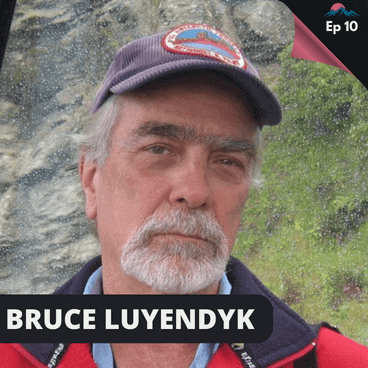
The first time Bruce Luyendyk flew over Marie Byrd Land, he thought the name was wrong. Not inaccurate — just insufficient. Below him, stretching to the curve of the Earth, was a coastal wilderness so hostile it had broken sledges, killed dogs, and sent men back to their ships half-starved. The Americans called it Marie Byrd Land. Luyendyk, a geologist who had spent months preparing for the cold, the wind, and the isolation, thought it deserved something sharper. He called it Mighty Bad Land.
That was the 1980s. Luyendyk was there to test a hypothesis about plate tectonics — specifically, whether New Zealand and Antarctica had once been joined as part of the ancient supercontinent Gondwana. The data suggested they had. But data, in Antarctica, means fieldwork. And fieldwork means survival training, cargo planes with no heat, and camps where the wind doesn’t stop for weeks.
What he found, over the course of multiple expeditions, was not just proof of Gondwana’s breakup. He found something bigger: Zealandia, a submerged continent the size of India that had been quietly sitting beneath the Pacific for sixty million years. It wasn’t a plateau. It wasn’t a fragment. It was a continent — the eighth, if you count it — and almost no one knew it existed.
The turn towards ice.
Luyendyk didn’t plan to become an Antarctic geologist. He planned to read about them. As a college student, he devoured the accounts of Ernest Shackleton — the failed crossing, the open-boat escape, the return for his men. Shackleton didn’t discover much. But he survived everything. That, Luyendyk thought, was worth studying.
Years later, when the opportunity came to go south himself, Luyendyk said yes before he understood what it meant. Antarctica, he would learn, is not one landscape. It is a rotating catalogue of them: the Transantarctic Mountains, the Dry Valleys, the Ross Ice Shelf, the glaciers that move faster than you can walk. And Marie Byrd Land — remote, unmapped, and geologically critical.
The question Luyendyk brought with him was simple: how did Gondwana break apart? The answer required rock samples, magnetic readings, and seismic data from one of the least accessible places on Earth. It also required months in a tent, rationed food, and the kind of cold that turns breath into ice before it leaves your mouth.
The scale of Antarctica is something you can’t prepare for. You think you understand isolation, and then you get there, and you realise: there is nothing. No trees. No animals. Just ice and rock and sky.
— Bruce Luyendyk
A continent that vanished.
Zealandia wasn’t discovered in Antarctica. It was discovered in the data that came from Antarctica — and from the seafloor mapping that surrounded it. Luyendyk and his colleagues pieced together bathymetric surveys, gravity measurements, and geological samples from New Zealand, New Caledonia, and the submerged ridges between them. What emerged was a landmass that had once sat above sea level, then subsided over millions of years as the Pacific stretched and thinned.
It met the criteria for a continent: distinct geology, elevated crust, defined boundaries. It was roughly five million square kilometres — about two-thirds the size of Australia. And it had been underwater, largely ignored, since the Cretaceous.
Luyendyk coined the name in 1995. The concept took longer to gain traction. Continental definitions are contentious. Geologists argue over thresholds — how high does crust need to be? How distinct? By 2017, a team of researchers made the formal case for Zealandia in the Geological Society of America‘s journal. The argument held. Zealandia became, in the eyes of many scientists, the world’s eighth continent.
For Luyendyk, the discovery reframed everything. Antarctica wasn’t just a frozen archive of climate history. It was the anchor point for understanding how continentsrift, how oceans form, and how landmasses the size of subcontinents can disappear beneath the waves without anyone noticing for sixty million years.
Shackleton’s hut, still waiting.
Between expeditions, Luyendyk made a pilgrimage. Not to a summit or a pole, but to a hut. Shackleton’s hut at Cape Royds, built in 1908, still stands on the western shore of Ross Island. Inside: tins of food, wooden bunks, a stove, tools hung on nails. Everything exactly where it was left over a century ago. The cold preserves. Nothing rots.
Luyendyk walked inside and stood quietly. This was the room Shackleton and his men lived in before they tried — and failed — to reach the South Pole. It was history, frozen. Not reconstructed. Not interpreted. Just there.
That hut, he later said, reminded him why he kept going back. Antarctica isn’t just a laboratory. It’s a place where time slows down. Where the past doesn’t fade. Where you can stand in a room that hasn’t changed in over a hundred years and feel the weight of what it took to get there.
In this conversation.
We go into the fieldwork that shaped Luyendyk’s understanding of Gondwana’s breakup, the moment he realised Zealandia was more than a theory, and what it feels like to work in a place where the wind never stops. He talks about the survival training required before anyone sets foot on the ice, the first time he saw the Transantarctic Mountains from the air, and why he wrote Mighty Bad Land — a book whose title captures both the humour and the danger of Antarctic geology. We also hear about Mount Luyendyk, the peak named in his honour, and what it means to have your name on a map of a continent most people will never visit.
Call to adventure.
Go somewhere where you can’t see evidence of civilisation. Not a park. Not a trail with markers. Somewhere wild enough that you feel the absence of everything else. Alaska and Patagonia both offer this, Luyendyk says, but the location matters less than the commitment. Spend time alone. Let the quiet do its work. Experience what it feels like to be small in a landscape that doesn’t care whether you’re there or not.
Pay it forward.
Luyendyk supports the World Wildlife Fund — not because it’s fashionable, but because the numbers are undeniable. Wildlife populations are collapsing. Habitats are shrinking. The WWF works at a scale large enough to matter, addressing both the symptoms and the causes. If you’re young, Luyendyk suggests getting involved directly. If not, donate. The work doesn’t happen without funding, and the need isn’t slowing down.
About Bruce.
Bruce Luyendyk is a geologist, professor emeritus at the University of California, Santa Barbara, and the scientist who named Zealandia. He has spent decades researching Antarctica’s geology, plate tectonics, and the breakup of Gondwana. There is a mountain in Antarctica named after him. He is also the author of Mighty Bad Land, a book that chronicles his expeditions to one of the most remote and unforgiving regions on Earth.
You don’t go to Antarctica once. You go back. Luyendyk did — again and again, chasing questions that required ice, rock, and time. What he found wasn’t just data. It was a continent that had been hiding in plain sight, and a reminder that the Earth still has secrets worth uncovering. Press play.


