
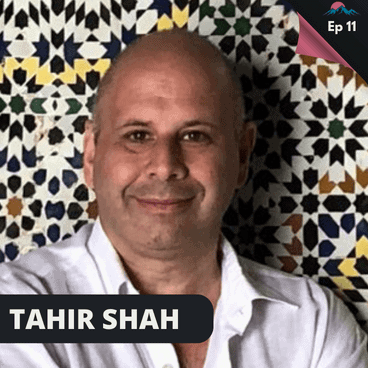
The house in Casablanca came with a reputation. Dar Khalifa, a crumbling estate in the old medina, had been empty for years. The neighbours said it was haunted — not by ghosts exactly, but by jinn. Genies. Tahir Shah bought it anyway. Not despite the stories, but because of them. A house with that much lore, he reasoned, had to be worth saving. The restoration took years. The jinn, he says, stayed.
Shah’s life has been built on decisions like that: choosing the harder route because it promises better material. A documentary filmmaker and writer who has worked with National Geographic and the History Channel, he has spent decades chasing stories across continents — searching for King Solomon‘s mines in Ethiopia, lost treasures in Afghanistan, oral traditions in Morocco. But the story he tells on Adventure Diaries that lands hardest is the one about the time he ended up, by bureaucratic mistake, in a Pakistani torture prison.
He does not say how long he was held. What he does say is this: survival in that context was not about strength. It was about narrative. Keeping his mind intact meant keeping his stories intact. When everything else is taken, what you remember becomes the only territory you still own.
The roots of adventure.
Shah grew up in Langton House, a sprawling estate in the southeast of England previously owned by the founder of the Boy Scouts. The house itself seemed to encourage a certain kind of childhood — one spent exploring, getting lost, constructing elaborate games in overgrown gardens. But it was the people who passed through that shaped him. Writers, intellectuals, thinkers. His family treated storytelling not as entertainment but as obligation. Stories were how you preserved culture, how you taught without preaching, how you made sense of a world that resisted simplicity.
He carried that ethos into his work. His documentaries were not travelogues. They were excavations — literal and figurative. In Ethiopia, he followed rumours of Solomon’s legendary mines, threading through oral histories passed down over centuries. In Afghanistan, he traced the path of lost treasure, navigating a landscape scarred by war and still thick with suspicion. The work was hard, often dangerous, and always uncertain. But each project added another layer to his understanding of how cultures encode their truths in objects, places, and — most of all — in the stories they refuse to let die.
The Moroccan connection.
Morocco was not a destination for Shah. It was a return. His family had deep ties to the country, and when he bought Dar Khalifa, it was less an investment than an anchoring. The house was enormous, historically significant, and — according to local consensus — occupied. The jinn were not metaphorical. Builders refused to work certain rooms. Neighbours warned him. Shah listened, but he did not leave.
Restoring the house meant restoring its context. He could not strip it back and modernise without erasing what made it matter. So he worked with craftsmen who knew the old techniques, who understood that a house like this was not just architecture but a living record. The process was slow, expensive, frustrating. But it taught him something he had suspected for years: that respecting a place means accepting it on its own terms, jinn and all.
Turn off your mobile phone…come to Morocco…use it as a camera…But don’t use Google Maps. You know, get lost, meet people, enjoy yourself in a way that is becoming less and less obvious.
— Tahir Shah
He means it literally. Not as a romantic gesture but as a practice. Getting lost, he argues, is the point. The zigzag route back teaches more than the straight line ever could. In Morocco, this philosophy is not theory. It is survival, navigation, discovery. The medina does not yield to logic. You learn it by failing to find your way, by asking strangers, by ending up somewhere you did not intend and realising it was better than where you were headed.
In this conversation.
We hear about the wrongful imprisonment in Pakistan — not the mechanics of bureaucracy, but what it does to a mind when the only thing left to control is memory. We go into the documentary work: the search for Solomon’s mines, the months spent in Ethiopia following oral histories that twisted and contradicted, the tension between what a culture says happened and what the ground reveals. Shah talks about his children, about how he tells them stories the way his family told him — not from books, but from memory, building narrative as a shared act. And he explains why Dar Khalifa mattered enough to fight for, why a house full of jinn was worth more than a renovated shell.
Call to adventure.
Turn off Google Maps. Not forever — just for a day. Go somewhere unfamiliar and do not optimise the route. Let yourself get lost. Not dangerously, not recklessly, but deliberately. Take the wrong turn. Ask someone for directions. End up somewhere you did not plan. The greatest adventures, Shah insists, are not the ones you chart in advance. They are the ones that happen when the map stops working and you have to pay attention instead.
Pay it forward.
Shah supports Each One Teach One, an organisation in India that funds education for children living on railway tracks outside Delhi. The model is simple: they pay for your schooling all the way to university level. In return, once you are stable, you fund someone else’s education. It is micro-scale, unglamorous, and it works. Shah calls it the kind of thinking we need more of — not grand gestures, but small, self-replicating acts of care that compound over time.
About Tahir.
Tahir Shah is a writer, documentary filmmaker, and storyteller whose work has taken him from the highlands of Ethiopia to the medinas of Morocco. He has produced films for National Geographic and the History Channel, written extensively on travel and culture, and currently lives in Casablanca in a house he restored over several years. He grew up in Langton House in England, a former home of the Boy Scouts’ founder, in a family that treated storytelling as a form of inheritance.
The jinn, Shah says, are still there. He hears them sometimes — or thinks he does. The house creaks in ways houses do, but the neighbours insist it is more than that. He does not argue. A place that holds that many stories, he has learned, is never truly empty. And that is fine. Better a house full of ghosts than one scrubbed clean of memory.


