They’re chest-deep in floodwater, tangled in forest, rain hammering down. No higher ground. The GPS won’t lock. The evangelical guide — a reformed petrol runner for the traffickers — looks at Pete and says, “Don’t worry. This is a beautiful place to die, and the day you die is the best day of your life.” Pete’s shaking. He thinks: if the piranhas take me, at least my last GPS waypoint will find the bones. It’s dusk. An hour of light left, maybe less.
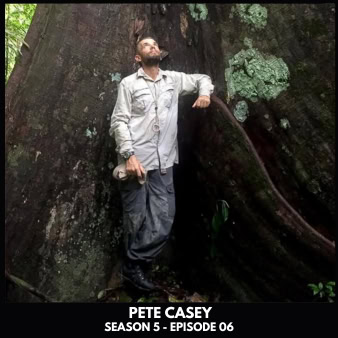
Pete Casey grew up in Sussex with no TV for years, always climbing things, always outside. He never flew until his mid-twenties. Adventure was something other people did — something he saw in films. He tried to get into the National Film and Television School three times and failed. He worked baggage handling for British Airways, then construction, paying off a mortgage. Photography and cinematography stayed with him, a quiet fascination he couldn’t shake.
In 2008 he flew to South America for the first time, chasing a slot on Ed Stafford‘s Walking the Amazon expedition as a photographer. He didn’t get it then, but he went back. A year later he walked with Stafford and his guide for a few weeks, filmed the finish, took hundreds of photographs. When the building work felt like a treadmill and a close friend took his own life, Pete sold his flat — twenty years of equity, £110,000 — and committed. Between 2013 and 2019 he completed the first sea-to-source ascent of the Amazon River: 7,000 kilometres, six and a half years, entirely human-powered, much of it swimming against the current.
Going upriver.
Nobody had done a sea-to-source Amazon ascent before because it made no sense. Rivers flow downhill. Pete thought: if I do the opposite, it’s a first. He spent two years planning a Nile walk, couldn’t get sponsors, then met another explorer in London who’d beaten him to it. He gave the man his domain name and turned to the Amazon. He studied Google Earth obsessively, plotting the route five or six times, storing waypoints, learning the topography. He trained in open-water swimming. He learned Portuguese. He had no team, no fixers waiting on the ground, no wealthy backers. He got on a plane and arrived in South America practically alone.
The method: swimming and trekking.
Pete swam across the rivers and lakes. He hired local guides to walk with him through the flooded forest, trained them to navigate on compass bearings, packed his kit into an Alpacka Scout packraft. The guide would paddle the raft with both backpacks; Pete would swim alongside. On bigger rivers he hired a motorboat and swam next to it. On smaller crossings he timed the tidal flow and used the incoming tide to push him upriver. The first big river, they told him there was a venomous sea serpent in the water. He swam it anyway, got swept into the mangrove forest, pulled himself out through waist-deep mud while Ed Stafford filmed from a motorboat and shouted warnings about stingrays.
This is a beautiful place to die, and the day you die is the best day of your life.
— Pete Casey’s guide, chest-deep in floodwater
The Una and the villages.
The Una communities were the first major indigenous group Pete encountered. They’d never seen a packraft. He let the kids play with it, gave away compasses, trained each guide to walk on a bearing. Entering villages was always tense — the Una have a terrible history of abuse from loggers and the rubber trade, and they’re one of the most defensive tribes in the Amazon. Pete once climbed out of a river in a rainstorm and the whole village was standing there staring. His guide had to explain everything to the chief. Another time they threatened to kill him. When the villagers were drunk on cauim — fermented manioc — he was threatened a lot. But when they sobered up, it was usually fine. Most of the time people were curious, hospitable, kind.
Twenty-three days, no food.
A year into the expedition, Pete tried to cross inland during flood season to reach the Rio Purus. He planned for fifteen days. It took twenty-three. The last five days: no food. He and his guide were up to their chests in water, passing through submerged forest. Pete couldn’t get a GPS signal. He thought they were going to die. He sent an emergency message to his friend Clive back in Manaus, who studied the topography in the middle of the night and sent back a bearing to possible higher ground half a kilometre away. Pete swam towards it, got swept deeper into the forest, forgot where he’d come from, made it back to the guide. They kept moving and found a scrap of ground just above the waterline, hung their hammocks, gasped and coughed through the night. A passing passenger boat rescued them from the riverbank the next day. Pete looked like a skeleton. He went back to Manaus and stayed for five months, joined a gym, built an extension on Clive’s house, improved his Portuguese, planned the next leg. He decided: no more rushing. It’s going to take as long as it takes.
Coca leaf plantations and the mochileros.
In the latter stages, out of the Amazon and into the Andes, Pete walked through drug-trafficking areas. He took a shortcut through coca leaf plantations on his own because he couldn’t afford a guide. He stopped at a farmhouse, ate dinner, went out the next day with people picking coca leaves. He met a gang of growers who pointed him across a field and up a little mountain. He hacked through the plantations, climbed for two hours, found a mule track at the top. A man in a village of six houses told him: this is a trafficker route, the mochileros come through here thirty at a time, if they find you they’ll push you off the cliff. Pete walked it alone. He had quite a lot of luck there.
In this conversation.
We hear how Pete went from a working-class upbringing in Sussex with no adventure background to selling his home and committing everything to a six-and-a-half-year human-powered ascent of the Amazon. We hear about the planning with Google Earth, the decision to swim the river crossings, the near-death experience in the flooded forest, the five months in Manaus recovering and rebuilding. We hear about the Una communities, the cauim-fuelled threats, the coca plantations and the mochileros, the Wellington boots that solved his foot problems, the farinha that became his gold food, and the financial reality of coming home to a closed bank account and a stolen bicycle outside the food bank.
Call to adventure.
Get off the screen. Get outside. When Pete was younger and struggling, the only thing that helped was exercise — swimming, running, jogging, a hundred lengths at the pool. Walking through a forest when you’re feeling down. Running is free. And if you’ve got the money and the desire for something bigger: South America. Peru, Chile, Patagonia, Venezuela, Colombia, Brazil. The continent is so vast you could spend a lifetime adventuring there. It’s not as dangerous as it’s perceived. And don’t always doubt yourself. Believe in yourself. You can do things you would never dream of doing.
Pay it forward.
Pete recommends Junglekeepers, an organisation founded by Paul Rosolie that retrains loggers to be forest guardians — paying them triple what they earned logging to protect the rainforest instead. They’re protecting more and more sections of the Amazon, and Pete says anyone who cares about deforestation should take a look at their website and give them support.
About Pete.
Pete Casey is the first person to complete a sea-to-source ascent of the Amazon River. He is a member of the Explorers Club, has spoken at their New York and London chapters, and is working on a book about the expedition. He lives in the UK, works part-time in construction, and is planning to return to Peru this year to pursue guiding and expedition options. You can follow his work at ascentoftheamazon.com and on Instagram at @p.c.casey.
That night in the flooded forest, Pete and the guide found the scrap of ground. They hung their hammocks above the water, coughing, shaking, breathing hard. It was dusk. The guide said it was a beautiful place to die. Pete thought about his last GPS waypoint, about bones and piranhas and rescue. In the morning the water was still there, but so were they. They kept moving.