
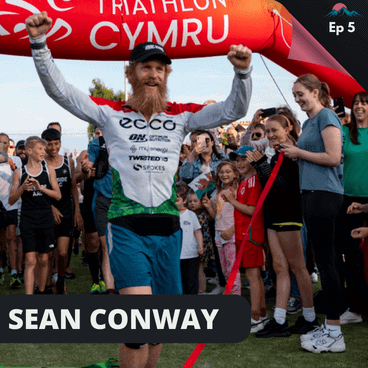
The first thing that breaks during an ultra-endurance challenge is not the body. It is the certainty that you will finish. Sean Conway learnt this somewhere around day seventy of his attempt to complete 105 consecutive Ironman triathlons — one per day, no rest, no time off. By then, the support team had stopped asking how he felt. They were watching the data instead: heart rate variability, calorie intake, sleep quality, the millimetres of muscle loss measured daily. They were waiting for something to give.
Conway had swum the length of Great Britain. He had cycled it. He had run it. He had set world records doing things most people would not attempt once. But 105 triathlons back to back was different. It was not about speed or distance. It was about whether the human body could recover fast enough, consistently enough, to do the same thing again the next morning. And the morning after that. For fifteen weeks.
He finished. On day 105, he crossed the line and became the first person to complete 105 consecutive Ironman-distance triathlons. No one had done it before because no one had worked out how.
Conway grew up in Zimbabwe. He did sport at school — most kids did — but stopped the moment he left. No facilities. No mentor. No one to tell him it mattered. He spent his twenties doing nothing physical at all. Then, in his early thirties, something shifted. He started running. Then swimming. Then he started asking himself what would happen if he did not stop.
The first big challenge was swimming the length of Great Britain. He had never swum in open water before he started training for it. The English Channel, the Irish Sea, the North Atlantic — he learnt as he went. It took 135 days. He vomited most mornings. Jellyfish stings became routine. He finished anyway. Then he cycled the length of Britain. Then he ran it. Three world firsts. Three different disciplines. Each one harder to recover from than the last.
By the time he started planning the 105 triathlons, he had developed what he calls the ten pillars of endurance. Not a training plan — a framework. Planning. Experience. Fitness. Health. Nutrition. Hydration. Sleep. Muscle management. Motivation. Community. Every pillar had to hold. If one cracked, the whole structure would collapse.
I am a big fan of multi-day stuff and I think everyone needs to plan a week long challenge in their life. Whether it’s running, walking, cycling, just choose something that takes about a week and you’re self-supported. I think you’ll really discover a lot about yourself and I think that will pay dividends across all aspects of your life.
— Sean Conway
The ten pillars sound theoretical until you try to live by them for 105 days. Nutrition meant consuming enough calories to sustain the daily burn — sometimes over 8,000. Sleep meant managing the narrow window between finishing one triathlon and starting the next. Muscle management meant daily physio, ice baths, compression, monitoring every twinge for the warning signs of injury. Motivation meant finding a reason to keep going when the body had stopped producing endorphins and the mind had stopped registering novelty. Community meant the support team, the people who showed up to cheer, the messages from strangers, the letter from Prince William that arrived mid-challenge and sat on the dashboard of the support van like a talisman.
Conway did not try to go fast. He tried to stay consistent. Same pace. Same fuelling strategy. Same sleep routine. The support team monitored everything in real time and made adjustments — more carbohydrate here, an extra hour of sleep there, a change in pacing to protect the knees. They were not managing an athlete. They were managing a system that had to function every day for fifteen weeks without catastrophic failure.
By day ninety, the challenge had stopped being about endurance. It had become about whether Conway could hold his focus long enough to reach the end. The body was doing what it had been trained to do. The mind was the variable. He set time targets. He tracked progress. He reminded himself that the only way out was through.
On day 105, he finished. The data held. The pillars held. He had proved it was possible — not just for him, but for anyone willing to build the system that would carry them through.
In this conversation.
We hear how Conway approaches pacing and nutrition across a challenge that lasts months, not hours. He talks about the role of the support team in monitoring performance and making real-time adjustments when the data shifts. He reflects on the moment he received a letter from Prince William mid-challenge, and what it meant to have that kind of recognition while still in the middle of the hardest thing he had ever done. The conversation goes into the mindset required to wake up every morning and do it again — the hunger for big, scary goals, the willingness to fail, the discipline to trust the process even when the body stops responding. Conway also discusses his childhood in Zimbabwe, his years of doing no sport at all, and the question that started everything: what happens if I do not stop?
Call to adventure.
Plan a week-long challenge. Not a day. Not a weekend. A week. Choose something you can do self-supported — hiking the West Highland Way, cycling Land’s End to John o’Groats, running a route you have always wondered about. Take the time off work. Commit to it. Conway believes that multi-day challenges teach you things about yourself that single-day efforts never will. The discomfort, the fatigue, the problem-solving, the quiet moments when no one is watching — that is where the discovery happens. Do not just do a marathon. Do something that takes longer than your body wants to give.
Pay it forward.
Get kids into sport. Conway is raising money for the True Adventure Foundation in North Wales, where only 39 per cent of children do sport outside of school. He believes that figure should be closer to seventy, ideally higher. If you know kids — your own, your nieces, your nephews, your neighbours — encourage them to join a club, try a sport, find something they can do regularly. Conway stopped doing sport after school because he had no facilities, no mentor, no one to tell him it mattered. He spent his twenties doing nothing. He does not want that for anyone else. Sport changes lives. If more kids did it, he says, it would change the world.
About Sean.
Sean Conway is an ultra-endurance adventurer who has completed three world-first expeditions: swimming, cycling, and running the length of Great Britain. He holds the world record for completing 105 consecutive Ironman-distance triathlons. He grew up in Zimbabwe, spent his twenties doing no sport at all, and now mentors athletes and raises awareness for youth sport initiatives. He lives in North Wales.
On day 105, Conway crossed the line and the data finally stopped mattering. The pillars had held. The system had worked. He had proved that the body could recover fast enough, consistently enough, to do the impossible. Press play to hear how.