
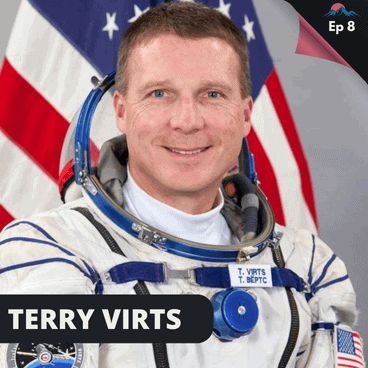
The first time Terry Virts looked down at Earth from 400 kilometres up, he couldn’t see the borders. Not the ones between Russia and Ukraine. Not the line dividing North and South Korea. Not the frontier between Israel and Palestine. From the International Space Station, moving at 28,000 kilometres per hour, the planet looked like what it actually is: one fragile system, spinning in a vacuum, held together by nothing but gravity and luck.
Virts spent 200 days aboard the ISS. He commanded it. He conducted spacewalks. He managed a crew that included Russian cosmonauts during one of the most geopolitically tense periods since the Cold War — Crimea annexed, sanctions imposed, tempers flaring on Earth while six people floated overhead, sharing a kitchen and a toilet and the view of home.
But before any of that, before NASA, before the shuttle, before the Soyuz capsule that carried him up through the atmosphere like a controlled missile strike, Virts flew F-16s. Fast, low, and often alone. The kind of flying where a mistake at Mach 1.5 doesn’t give you time to think about what went wrong.
The turn from fighter pilot to astronaut.
Virts didn’t grow up dreaming of space. He grew up wanting to fly. The fighter pilot training was brutal — high-speed manoeuvres, split-second decisions, the physical toll of sustained G-forces that compress your organs and blur your vision. But it taught him something NASA would later depend on: how to stay calm when systems fail, when the radio goes quiet, when you’re alone and running out of options.
The transition to astronaut wasn’t inevitable. It required applying, failing, applying again. It required learning Russian. It required sea kayaking in Alaska — not as recreation, but as survival training. Paddling through icy water in fjords where orcas surfaced without warning and eagles circled overhead. The exercise wasn’t about paddling. It was about leadership, teamwork, and what happens to your decision-making when you’re cold, tired, and the nearest help is two days away by boat.
Don’t tell yourself no when pursuing your dreams.
— Terry Virts
Flying the space shuttle, Virts says, was nothing like flying an F-16. The shuttle didn’t have ejection seats. It didn’t have engines you could restart if something went wrong on ascent. You strapped in, lit the solid rocket boosters, and committed. Eight and a half minutes later, you were either in orbit or you were dead. The margins were that tight.
Two hundred days aboard the station.
Living on the ISS for 200 days meant eating food from vacuum-sealed pouches, sleeping in a bag tethered to a wall, and working sixteen-hour days conducting experiments, repairing equipment, and managing a vehicle the size of a football field that cost over 100 billion dollars to build. It also meant taking thousands of photographs — not just for science, but because the view was the one thing that never got old.
Virts spent months trying to organise those photos. Thousands of images of Earth: auroras, lightning storms, cities lit up at night, deserts, glaciers, rivers carving through continents. The sheer volume was overwhelming. But the perspective they offered was irreplaceable. From orbit, political borders don’t exist. You see ecosystems. You see weather systems. You see one planet, not two hundred countries.
The geopolitical reality, though, followed him up. During his mission, Russia annexed Crimea. Sanctions hit. Tensions rose. On Earth, politicians postured. On the ISS, Virts and his Russian crewmates still shared meals. Still trained together. Still depended on each other for survival. The disconnect was surreal. He describes floating in the Cupola — the ISS observation module — watching Russia and Ukraine pass beneath him, knowing what was happening on the ground, knowing that the only way he was getting home was inside a Russian Soyuz capsule.
Spacewalks, Virts says, were the high point. Not because they were easy — they weren’t. A spacesuit is a miniature spacecraft. It weighs 130 kilograms on Earth. It takes hours to put on. Outside, tethered to the station, moving in slow motion because one wrong move could send you tumbling into the void, you’re completely alone except for the voice in your helmet and the curve of Earth filling your peripheral vision. The work is precise: replacing equipment, running cables, tightening bolts while wearing gloves so thick you can barely feel your own fingers. But the view. The view makes it worth it.
In this conversation.
We go into the technical realities of flying both the space shuttle and the Russian Soyuz — two completely different machines with completely different philosophies. We hear about the emergency procedures, the simulations, the moments when things went wrong and the only option was to troubleshoot in real time. Virts talks about the future of space travel: the Artemis programme aiming to return humans to the Moon, the competition between SpaceX and Blue Origin, and why private-public partnerships are reshaping what’s possible. We also hear about his relationship with the Russian cosmonauts, the strange intimacy of living in close quarters with people whose government is in conflict with yours, and what it takes to maintain professionalism when geopolitics intrudes on orbit.
Call to adventure.
Go sea kayaking in Alaska. Not a guided tour — an expedition. Multi-day, cold water, no phone signal. Learn what it feels like to rely on your own judgement when the weather changes and the nearest help is hours away. Watch for orcas. Watch for bears. Disconnect completely. Virts credits that training with teaching him more about leadership and survival than any classroom ever did. If you can’t make Alaska, find the equivalent: a place where nature is indifferent to your presence and you have to earn your way through it.
Pay it forward.
Support Guide Dogs for the Blind. The organisation trains guide dogs to give visually impaired individuals independence, mobility, and companionship. Virts speaks about the documentary Pick of the Litter, which follows the journey of guide dogs and their trainers — the emotional investment, the years of work, the profound impact these animals have on human lives. It’s a cause that combines compassion, skill, and patience. If you’ve ever had a dog, you know what they’re capable of. This takes it further.
About Terry.
Colonel Terry Virts is a former NASA astronaut, retired U.S. Air Force pilot, and veteran of two spaceflights. He has logged over 200 days in space, commanded the International Space Station, and conducted spacewalks. Before NASA, he flew F-16s. After space, he became a filmmaker, photographer, and author. He lives in Colorado.
From the cockpit of an F-16 to the Cupola of the ISS, Virts has spent his career looking at Earth from angles most of us will never see. The borders we draw, the conflicts we fight, the systems we build — none of it looks the same from 400 kilometres up. Press play.


