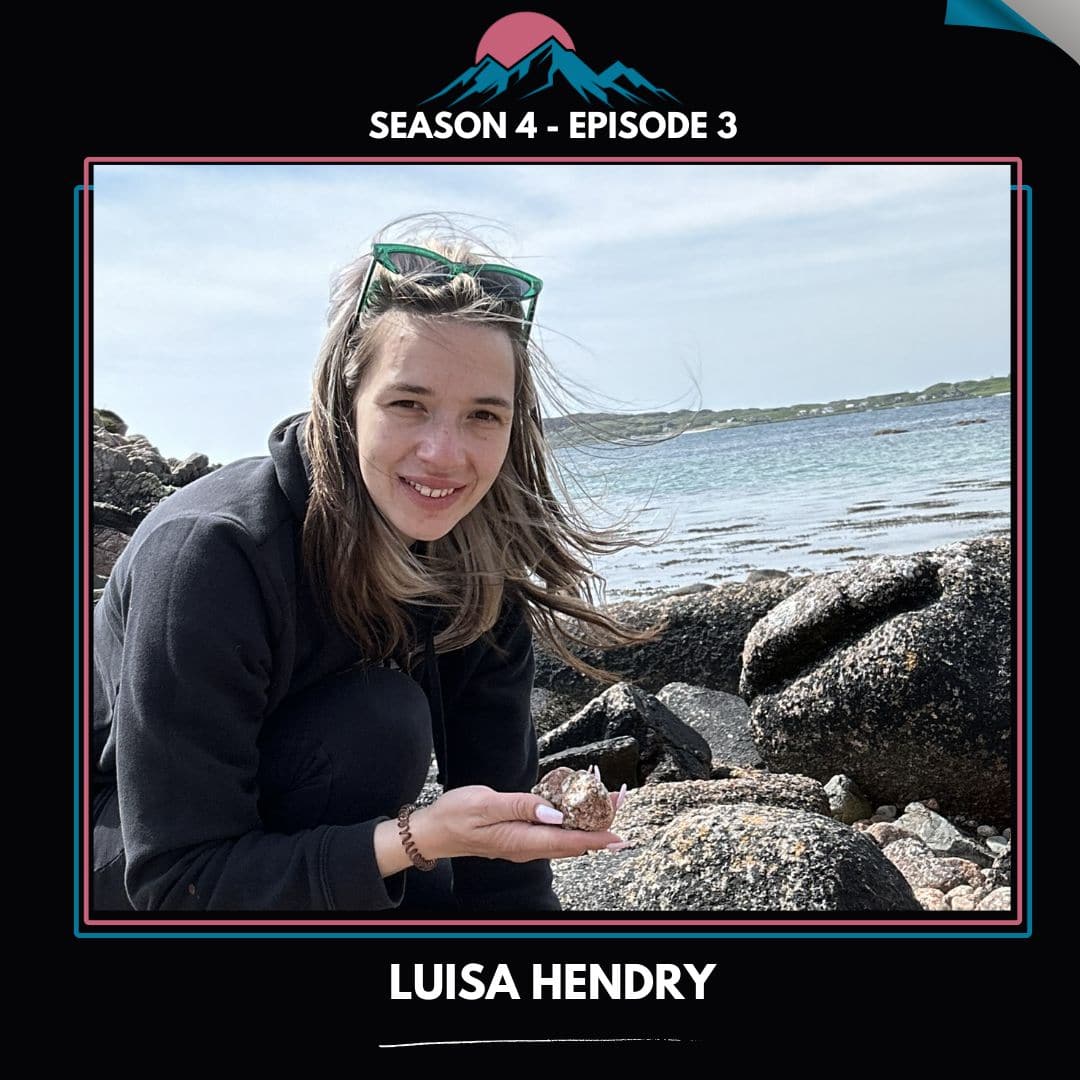
She hands her mum her phone and stands beside a rock face in the Northwest Highlands. No script, no rehearsal. She just starts talking about the billion-year-old rocks behind her — their origin, their journey, their story. Then she films herself running towards another outcrop, phone in selfie mode, explaining the frustration of spotting a beautiful rock face when you cannot even park beside it. Within three months, 100,000 people are following her. The geologist who was told to “speak properly” has gone viral by doing exactly the opposite.
Luisa Hendry grew up in Largs, a wee coastal town where she spent her childhood smashing open rocks on the beach, searching for geodes she would never find. She loved those disaster films about volcanoes erupting in the wrong places, but never knew geology was a subject you could actually study. At 16, she wandered into a university open day at Glasgow, saw a stall covered in rocks and a picture of a volcano, and thought: can you really study this? When they said yes, everything changed.
After graduating in 2015, she worked in civil and engineering geology for nine years. Today she runs Scot Rock Walks — Scottish Geology Tours Ltd — taking people across the Highlands, the Isle of Skye, Lewis and Harris, and Loch Lomond to see Scotland’s landscapes through the lens of deep time. Her Instagram and TikTok channels as The Scottish Geologist have made her one of the most recognisable voices in science communication in the UK. She speaks in her own accent, swears when it fits, and explains plate tectonics like she is telling you a story in the pub. She left her full-time job in August this year to build the business properly. Next year she has American clients booking private geology tours and a book deal in early conversations.
Scotland’s geological passport.
The Highland Boundary Fault cuts through Loch Lomond like a geological border crossing. South of it: the flat Lowlands where Glasgow sits. North of it: the drama of the Highlands, mountains rising sharply from the water. The fault was active around 450 million years ago, a normal fault line where the Midland Valley terrain dropped while the Highlands uplifted. Those mountains are the Dalradian Supergroup — rocks originally deposited as horizontal layers in the ancient Iapetus Ocean, then buckled, squeezed, and metamorphosed during the Caledonian Orogeny. The same tectonic collision that built the Himalayas happened here, long before India even existed as a landmass. Scotland once sat joined to North America and Norway as part of the supercontinent Pangaea. A billion years ago, it was near the South Pole. During the Carboniferous period it sat at the equator, growing the tropical forests that became coal.
Rocks are made of stories.
Granite forms deep underground when continental crust melts under immense heat and pressure, then cools slowly inside a magma chamber. Because it cools slowly, the minerals inside — quartz, mica, plagioclase feldspar — have time to crystallise into large, interlocking grains. That is why you can see the individual crystals when you pick up a piece of granite. Oil, by contrast, is dead organic material — usually marine organisms — compressed in fine-grained shales over geological time, then migrated under pressure into porous sandstone reservoirs. The top of Mount Everest is limestone, a shallow marine rock. It was underwater before it became the highest point on Earth.
Everything in this room — that microphone stand, the glass in this cup, that coaster — it all comes from the ground.
— Luisa Hendry
The rate of change.
Climate has always changed. The geological record shows temperatures rising and falling over millions of years, driven by volcanism, orbital shifts, ocean circulation. Five mass extinction events have been triggered by climate change in Earth’s history. But the difference now is speed. When you look at the temperature and CO₂ records over geological time, the changes happen slowly — over millions of years. What we are seeing now is that same graph going almost vertical in the space of 100 to 200 years. That rate of change is unlike anything in the geological record caused by natural processes.
In this conversation.
We hear how Luisa went from engineering geologist to viral educator and tour guide, why she started making videos in her own voice after being told to speak properly, and how she turned a VW Transporter into a mobile geology classroom. We learn what the Highland Boundary Fault actually is, why granite forms deep underground, how India collided with Asia to build the Himalayas, and why Scotland once sat at the equator. We hear about convergent and divergent plate boundaries, the difference between rocks and minerals, and why the word cleavage makes geology audiences try not to laugh. And we hear why being yourself — accent, swearing, enthusiasm and all — is the most powerful thing you can do.
Call to adventure.
Get out across the Highlands of Scotland and pay attention to the rocks. Next time you are at a beach, or hiking a hill, or driving past a road cutting — look at what is underneath. The Northwest Highlands especially — places like Melvaig Bay near Gairloch, Durness on the north coast — these locations have some of the oldest and most dramatic rocks in the world. You do not need to be a scientist. Just look. These landscapes took billions of years to form and they belong to all of us.
Pay it forward.
Luisa supports charities that help large breed dogs like huskies, Malamutes, and German Shepherds that are abandoned when people cannot handle them. She also supports breast cancer charities — her mum went through treatment and came out the other side.
About Luisa.
Luisa Hendry is a geologist, educator, and founder of Scot Rock Walks — Scottish Geology Tours Ltd. She graduated from the University of Glasgow in 2015 and worked in civil and engineering geology for nine years before leaving to build her geology tour business full-time in August this year. As The Scottish Geologist, she has built a following of over 100,000 people on Instagram and TikTok by making geology accessible, fun, and unapologetically Scottish. She runs weekend tours, day trips, and Sunday geology walks across Scotland, and has private bookings from international clients for next year. She lives with her dog Yodha, an Utonagan who occasionally joins the tours and rolls in seaweed.
She is pregnant, building a book deal, and still running towards rock faces with her phone in selfie mode. The billion-year-old boulders in the Northwest Highlands are still there, waiting. This time, she is bringing a van full of people who want to hear their story.