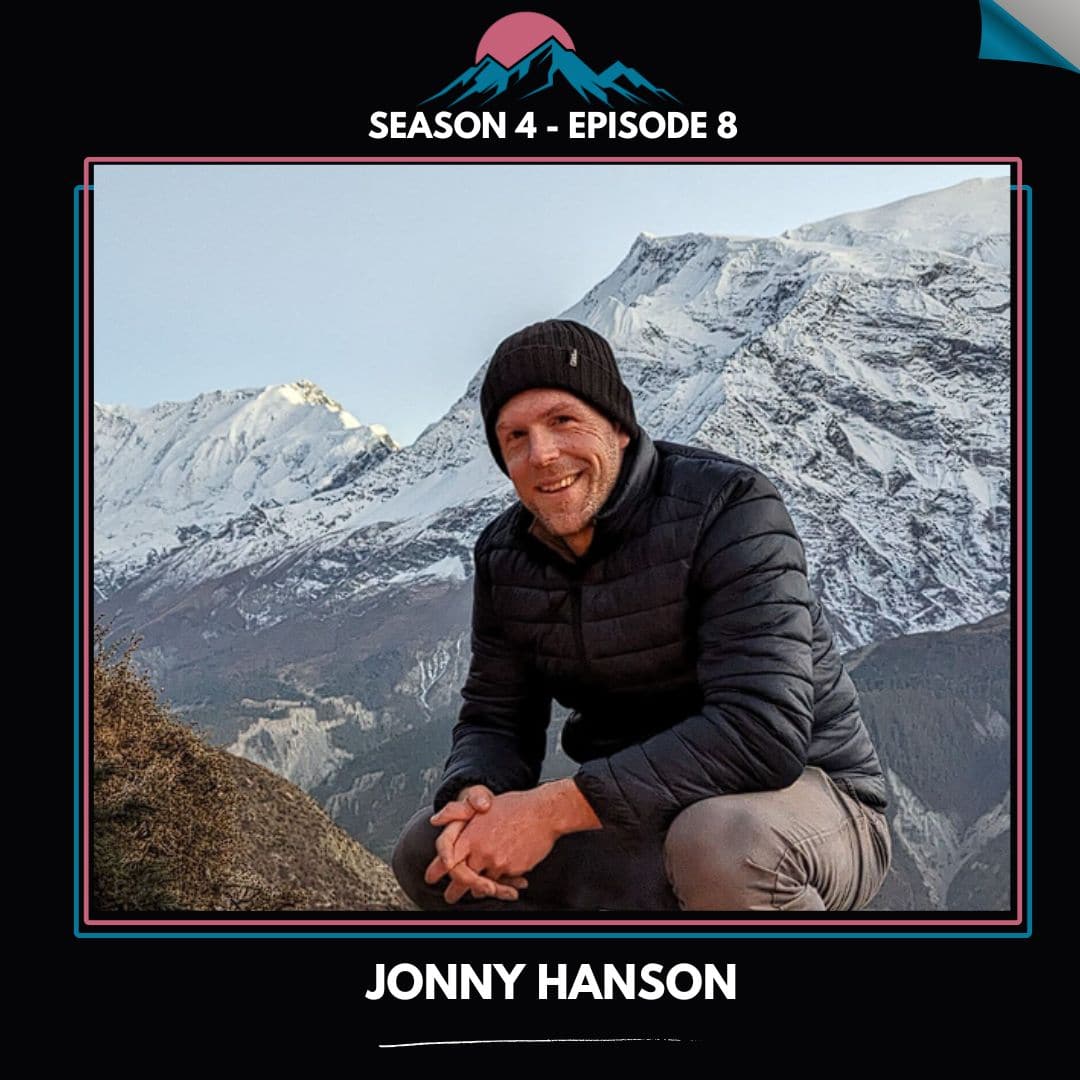
An adult female snow leopard and her three cubs break into a fenced corral in the Annapurna region of Nepal. By morning, a hundred sheep and goats lie dead. For Jonny Hanson, standing in the landscape filming a documentary, the WhatsApp message arrives like a punch. He has worshipped snow leopards his whole life — beauty personified, he calls them. But here is the other side of that beauty: a farmer’s livelihood decimated in a single night, children who depend on that herd suddenly vulnerable. This is the tension that runs through everything he does.
Jonny grew up between Ireland and Malawi, shaped by a father who smuggled Bibles through the Iron Curtain and cycled around the world, and by the hard mountains of southern Africa where he learned to walk and talk. He loved two things that seemed to contradict: big cats and farming. Instead of choosing, he built a career in the gap between them.
Today he is a lecturer at Queen’s University Belfast, a field researcher with the Snow Leopard Conservancy, and the author of Living with Lynx: Sharing Landscapes with Big Cats, Wolves and Bears. His work focuses on coexistence — how livestock farmers and large carnivores can share the same ground without one destroying the other. He has travelled across Europe, North America and the Himalaya, conducting 56 interviews with ranchers, rewilders, government officials and conservationists. His short film, Snow Leopard Trail, about community conservation in Nepal, will premiere this year.
From dodgy zoos to the Himalaya.
At 19, Jonny wanted to work with big cats. No sensible zoo would let him near anything dangerous, so he ended up in places with no health and safety — the kind of operations featured in Tiger King. He worked with jaguars, tigers, rhinos, crocodiles, tarantulas and wolf dogs. It was terrifying. It was also formative. During his final university summer, he went to Nepal and fell in love with the greatest mountain range on Earth. He decided he would return to do research there, and he did — a PhD on how small-scale farmers share landscapes with snow leopards, creatures that can wipe out a livelihood overnight.
Conflict between people over predators.
The real issue, Jonny says, is not conflict between people and predators. It is conflict between people over predators. The farmer, the rewilder, the scientist, the government official, the tourism entrepreneur — each holds a different version of what a lynx or a wolf means. To one it is beauty; to another it is a threat to seven generations of family farming. Coexistence hinges less on managing the animals and more on navigating the tension between those perspectives. Sharing landscapes with lynx, wolves and bears, he argues, is also about sharing landscapes with each other.
At the end of the day, sharing landscapes with lynx, wolves and bears is also about sharing landscapes with each other.
— Jonny Hanson
Illegal releases and the politics of rewilding.
In December, lynx were illegally released in the Cairngorms. They were captured quickly; one did not survive. In March, more sightings were reported in Dumfries and Galloway. The animals have not been caught. Jonny is clear: this is not the way to go about it. Extreme action leads to extreme counter-reaction. Years of trust-building work by conservation NGOs in Scotland and northern England have been set back, if not wiped out. The Scottish First Minister put a red pen through the idea of formal reintroduction. Rewilding, Jonny insists, is a social process done by people. Of all the things that make relationships work, trust is up there. These releases have damaged that trust badly.
Making it work economically.
Switzerland is half the size of Ireland with eight million people. Lynx were reintroduced in the 1990s. There was some predation of sheep, but compensation schemes and governance processes that allowed different voices to be heard made it work. Today, lynx are an established part of the landscape. Jonny met farmers there who said they were not worried about lynx — they rarely see them, they take the odd sheep, it is manageable. The lesson: if we want this to work in Britain and Ireland, we have to make it work for people. A lynx must become an asset, not just a moral cause. If a farmer can be 50 per cent better off financially by having the species in the landscape, that is a language that works. We need to make farmers an offer they cannot refuse.
In this conversation.
We hear how Jonny grew up between Ireland and Malawi, shaped by wild mountains and his father’s adventures. How he refused to choose between big cats and farming, and instead built a career studying coexistence. How he travelled across Europe, North America and the Himalaya interviewing ranchers, conservationists and government officials. How illegal lynx releases in Scotland have damaged years of trust-building. How Switzerland made lynx reintroduction work through compensation and governance. How the real conflict is not between people and predators, but between people over predators. And how rewilding is less about ecology and more about the politics of sharing landscapes with each other.
Call to adventure.
The greatest adventure is not the adventure without, but the adventure within. The greatest mountain range we face is not the mountains of Nepal but the mountains of the mind. Look after your mental wellbeing. Go into your inner landscape. Look after yourself — because life is hard, and it is worth taking care of yourself.
Pay it forward.
Jonny highlights the Snow Leopard Conservancy, a charity doing community-based snow leopard conservation across seven countries. They work from the grassroots with local communities, many of whom are livestock farmers, turning the snow leopard from a liability into an asset through tourism and participatory conservation.
About Jonny.
Jonny Hanson is a lecturer at Queen’s University Belfast and a field researcher with the Snow Leopard Conservancy. He grew up between Ireland and Malawi, studied at Queen’s, and completed a PhD on human-carnivore coexistence in Nepal. He set up and ran Northern Ireland’s first community-owned farm, working with refugees, asylum seekers and adults with learning difficulties. His book, Living with Lynx: Sharing Landscapes with Big Cats, Wolves and Bears, draws on 56 interviews across Europe, North America and the Himalaya. His short film, Snow Leopard Trail, about community conservation in the Annapurna region, will premiere this year. He is also a former 400-metre record holder at his high school and the front man of a band called Firebrand.
Somewhere in Nepal, a snow leopard moves through the high country, unseen. A farmer checks the corral at first light. A rewilder in Scotland reads the headlines. And in that space between them — the space Jonny has spent his life trying to understand — the future of coexistence is still being written.